Check out this captivating virtual journey deep into Intel’s cutting-edge semiconductor manufacturing facilities, where the technological engines driving our digital world are brought to life.
In this immersive experience, you can move around in a full 360 degrees (for most of the video it is worth moving your mouse around — high speed access and 4K is recommended, but not necessary). The video unveils the astonishing intricacies hidden within clean rooms that are 1,000 times cleaner than the most sterile hospital operating environments. Get an up-close view of the state-of-the-art, multimillion-dollar machinery that is essential for crafting the microchips powering our modern era. And for the truly adventurous, take a virtual spin along the automated superhighways that whisk silicon wafers through this sprawling technological labyrinth. [Remember – you can drag your mouse left, right, up, down.]
Intel Newsroom Video via YouTube 2023
What makes this tour even more fascinating is Intel’s pivotal role in addressing the surging global demand for semiconductors. As our world continues to depend on technology, the demand for these microprocessors skyrockets. Intel, with its history and advanced manufacturing prowess, is positioned to meet the need for chips.
As most MNT-EC Think Small readers know, the importance of ensuring a robust, sustainable, and secure semiconductor supply chain is paramount. To achieve this, in tandem with Intel and many other semiconductor manufacturers, we’re seeking to keep you updated on micro- nanotechnology programs across the USA with our community college partners (and we’re here to help them as they build new programs and need curriculum guidance and materials — if you are an educator or an administrator, you can learn more about our recent Intro to Nano Canvas course here).
Intrigued by the latest in technology and its transformative potential? You can peruse our MNT site, of course. You can also visit the Intel Newsroom which shares groundbreaking technology news covering developments in client computing, artificial intelligence, cybersecurity, data centers, and international news.
The Micro Nano Technology Education Center (MNT-EC) recently celebrated a significant achievement, with three of its evaluators being recognized nationally for their exceptional work. Terryll Bailey, Dr. Jalil Bishop, and Dr. Antar Tichavakunda have been instrumental in shaping the MNT-EC program, providing invaluable insights and recommendations that have helped the center excel in its mission.
Terryll Bailey, the founder and president of The Allison Group, brings over 20 years of experience in workforce development research and evaluation. Her firm specializes in external evaluation for numerous National Science Foundation projects and centers, including the MNT-EC. Bailey’s collaborative approach to evaluation has been crucial in integrating evaluative thinking into the project, focusing on evidence of impact on individuals and organizations.
Dr. Jalil Bishop, a critical qualitative scholar, has expertise in college affordability, student debt, anti-racist policymaking, and the racialized geography of life opportunity. His work on developmental evaluations has been instrumental in shaping the MNT-EC’s approach to equity and inclusion. As the principal investigator of the first national study on Black student debt, Dr. Bishop brings a unique perspective to the evaluation team.
Dr. Antar Tichavakunda, an Assistant Professor of Race and Higher Education at the University of California Santa Barbara, brings a wealth of knowledge in urban education policy. His research on college readiness, Black students’ experiences at predominantly White institutions, and the sociology of race and higher education has been invaluable in shaping the MNT-EC’s approach to diversity and inclusion.
The evaluators’ work has been lauded for its clarity, readability, effective use of visuals, and commitment to diversity, equity, and inclusion. Their conclusions and actionable recommendations, well-supported by evidence, have been “essential in informing this program and determining best practices to provide internships that most benefit underrepresented students,” Jared Ashcroft, Principal Investigator, said.
Jared Ashcroft, PI of MNT-EC, acknowledged the value of the evaluation data, stating, “The MNT-EC evaluation data was essential in informing this program and determining best practices to provide internships that most benefit underrepresented students.”
The evaluators worked closely with the project team, meeting regularly to discuss evaluation matters. This collaboration likely contributed to the thoroughness and accuracy of the report. They adhered to standards developed by the Joint Committee on Educational Standards and Evaluation, ensuring the ethical collection and analysis of data.
“The external evaluators have collected quantitative and qualitative data to bring numbers, context, and color to our Center’s dissemination efforts.”
⸺ Peter Kazarinoff, Co-PI of MNT-EC
The value of this comprehensive evaluation to a national center like MNT-EC cannot be overstated. It provides a roadmap for the center, highlighting areas of success and identifying opportunities for improvement. “The way the MNT-EC evaluation report was approached, aligned all activities and results within the framework of the evaluation and its design” according to Mel Cossette, Co-PI of MNT-EC. This feedback is crucial for the center to continue evolving and improving its programs. At a foundational level, this means that the center can better serve its students and the community, ensuring that its programs are effective, inclusive, and impactful.
The MNT-EC is deeply grateful for the evaluators’ contributions, which have not only helped shape the center’s program but also enhanced its ongoing work. Their collaborative efforts across different disciplines and outreach programs have been pivotal in increasing the effectiveness of the program. The MNT-EC is proud to acknowledge the exceptional work of these three evaluators and looks forward to continuing its mission of improving technical education at community colleges.
Specific Highlights from the 2022 Annual Evaluation Report
Website and Social Media Impact: The MNT-EC’s website and social media platforms have been successful in reaching a broad audience. The website’s traffic compares favorably to two mature national centers, averaging 3,738 users and 15,937 page views in its first year. The LinkedIn posts have also improved significantly, leading to increased impressions and interactions (Page 34).
Center Team and Management: The MNT-EC Center Team, including the PI, Co-PIs, working group leads, and experts from partner institutions, meets monthly to establish their annual goals aligned with the center goal. The Executive Team meets weekly, and the center has made significant progress toward its goals this year, identifying gaps and improving productivity (Page 19).
Advocacy for Systemic Change: PI Ashcroft advocates for systemic changes in technical education, emphasizing the need for more impactful start for students, more funded apprenticeships and internships, and long-term coordinated actions toward solutions. The MNT-EC Center is engaging in this advocacy and inviting other organizations to join in this endeavor (Page 36-37).
Focus on Diversity, Equity, and Inclusion: The MNT-EC has made a transformational approach to recruiting underrepresented minorities by working with existing student organizations that support underrepresented minorities and bringing the program into their existing framework. Over 90% of the students in the URE program are from underrepresented groups, representing eight community college campuses in five states (Page 37-38). The Talking Technician podcast receives special mention in here on Page 38.
Additional Evaluation Technical Details, from the report narrative, for those who want to know:
Their investigative approaches included objective orientation, teaching/learning process orientation, customer orientation, faculty and institutional support, business and industry support, and management. These approaches provided a complete review of the project, ensuring a comprehensive analysis of the project’s implementation, audience reach, user perceptions, resource usage, and systemic change.
The evaluators used evidence-based data to measure outcomes, employing both quantitative and qualitative data analysis methods. This approach allowed for a more nuanced understanding of the project’s performance. Their commitment to continuous improvement was evident in their plans to evolve assessment practices and understand the effectiveness of the program better.
Special thanks to EvaluATE, ATE Evaluation Resource Hub, for its work in educating evaluators, and others, about evaluation best practices. Their Resource Libraryis filled with webinars, newsletters, blogs, and information about the ATE annual survey. These materials are open-access. EvaluATE is supported by the National Science Foundation under grant number 1841783. This blog post builds partly from their post, linked above on their evaluation award page.
Mario is an intern at Intel, gaining hands-on experience in semiconductor manufacturing while pursuing his education. In this episode, Mario discusses how his internship is helping him build skills, network with industry professionals, and prepare for a full-time career in one of the world’s leading tech companies.
Show Notes
Mario secured an internship at Intel. Mario worked on submarines in the Navy. When he left the Navy, he needed a new career. Hear how Mario made the decision to work as an engineering technician intern and how his company is helping with his degree and coursework at community college. Mario’s story is inspirational and shows one of the different backgrounds that can lead you to work in the semiconductor industry.
The Talking Technicians podcast is produced by MNT-EC, the Micro Nano Technology Education Center, through financial support from the National Science Foundation’s Advanced Technological Education grant program.
Opinions expressed on this podcast do not necessarily represent those of the National Science Foundation.
Join the conversation. If you are a working technician or know someone who is, reach out to us at info@talkingtechnicians.org.
What Are KSAs and Why Are They Important for Your Future Career?
As you start exploring different career paths and preparing for your future, you may come across the term “KSAs.” But what exactly are KSAs, and why are they important?
MNT-EC, working with Industry Partners, including the SEMI Foundation and NIIT, created a document to help you navigate the Microsystems Process Technician career pathway.
In this blog post, we’ll break it down for you in simple terms.
What Are KSAs?
KSA stands for Knowledge, Skills, and Abilities, but are also known as competencies. Companies and schools often create KSAs to help clarify what specific job requirements are, what you will need for a specific role, and ways you can pick the courses to help you develop skills for that career path. Some companies will ask the job candidate to create or answer questions around their knowledge, skills, and abilities.
In a nutshell, these are the attributes and qualities you need for successfully performing a job. They are typically demonstrated through relevant experience, education, or training. Let’s take a closer look at each one, pulling in the definitions from the PDF directly:
Knowledge is a body of information applied directly to the performance of a function: How well does a student understand a concept theoretically?
Skills are observable competencies needed to perform learned psychomotor acts: How well can a student execute a specific activity?
Abilities are competencies to perform an observable behavior or behaviors that results in an observable product: Does the student meet expectations outside of strictly technical expertise?
By combining knowledge, skills, and abilities, you can showcase a well-rounded profile to employers. Building knowledge through learning, acquiring skills through practice, and leveraging your innate abilities create a strong foundation for career growth and success. Assessing and developing your KSAs can help you align with the requirements of your desired field and enhance your potential for professional advancement.
You can review the new MNT-EC KSA document below in the PDF reader, or click the download button to save it to your computer (below the embedded PDF, keep scrolling…).
Jason is a technician at Intel, where he works in semiconductor manufacturing, tackling the complex challenges of creating advanced chips. He shares insights into the precision required in his role, the global impact of his work, and how his technical training prepared him to succeed in a highly specialized field.
Show Notes
Jason works as a technician at Intel. Jason worked as a freelance videographer, but wanted a more stable profession. He graduated from a 2-year community college program and secured a job in the semiconductor industry at Intel. Hear how Jason’s career as a technician has grown and how Intel supports his professional growth.
The Talking Technicians podcast is produced by MNT-EC, the Micro Nano Technology Education Center, through financial support from the National Science Foundation’s Advanced Technological Education grant program.
Opinions expressed on this podcast do not necessarily represent those of the National Science Foundation.
Join the conversation. If you are a working technician or know someone who is, reach out to us at info@talkingtechnicians.org.
The Goldwater Scholarship is one of the most prestigious undergraduate scholarships awarded to students who excel in the fields of mathematics, natural sciences, and engineering. This year, two MNT-CURNstudents have been awarded the scholarship: Rachael Orkin from Los Angeles Pierce College and Celina Yu from Pasadena City College (PCC).
Rachael Orkin, a biochemistry major at Pierce (as it is often called), was inspired to pursue the Goldwater Scholarship after learning about it through guest speakers in her MNT-CURN meetings. She decided to apply for the scholarship after Dr. Jared Ashcroft included her in an email about Goldwater mentors who could help her through the process. With a support system that big, Rachael felt it was worth a shot applying for the scholarship.
Rachael has been involved in undergraduate research at Pierce with many opportunities that have validated her choice to pursue pathology and structural biology. She is currently doing research with electronic noses, biomechanic software, and leprosy, with plans to engage in other areas. Rachael is interested in researching how micro- nanotechnologies intersect with medicinal chemistry, organic chemistry, and biochemistry. She hopes to be a pathologist or clinical geneticist via an MD/PhD path.
Celina Yu, a first-generation college student, was motivated to pursue the Goldwater Scholarship not only for financial reasons but also to push her academic limits. She has been involved in undergraduate research at PCC and wanted to explore what’s out there. Applying for the Goldwater Scholarship was a way for Celina to stay involved and active during her sophomore year of higher education.
Celina recently received her Associates of Arts degree in Natural Sciences at PCC and has decided to concentrate in Biology upon her transfer to a 4-year institution this fall.
Her love for science is what inspired her to pursue her degree. She wants to create or discover new ways to develop medications or push the limits with novel methods to help others thrive. After her first research experience, Celina realized that she much prefers supporting those fighting on the front lines to help patients rather than going into battle herself. She wants to be part of the development team and supply the needed materials to continue to help people.
For the scholarship, Celina focused on her research involving gold nanoparticles and their use in traditional photothermal therapy.
She collaborated with the California State University of Northridge and used a custom-built Femtosecond laser to characterize the experimental samples. The subsequent data was analyzed to study the nanoparticle’s electronic transitions, and the concept of a hybrid particle was introduced to bring forth the idea of an alternative route for cancer treatment.
Both Rachael and Celina had mentors who helped them throughout the application process and research experience.
Rachael would like to thank her campus representative, Dr. Aron Kamajaya, and her application mentors Justice Charnae Robinson and Sophia Barber, as well as her research mentors Dr. Jared Ashcroft, Dr. David Armstrong, and Dr. Brian Pierson.
Celina would like to acknowledge her mentors Dr. Jared Ashcroft, Dr. Jillian Blatti, Dr. Abdelaziz Boulesbaa, Dr. Yadong Yin, and Kristin M. McPeak for being an amazing campus representative and helping with the official paperwork.
The Goldwater Scholarship is a significant achievement for both Rachael and Celina, and it demonstrates their dedication and passion for their fields of study. Their research has the potential to make a significant impact on society, and we wish them all the best as they continue to pursue their academic and research goals.
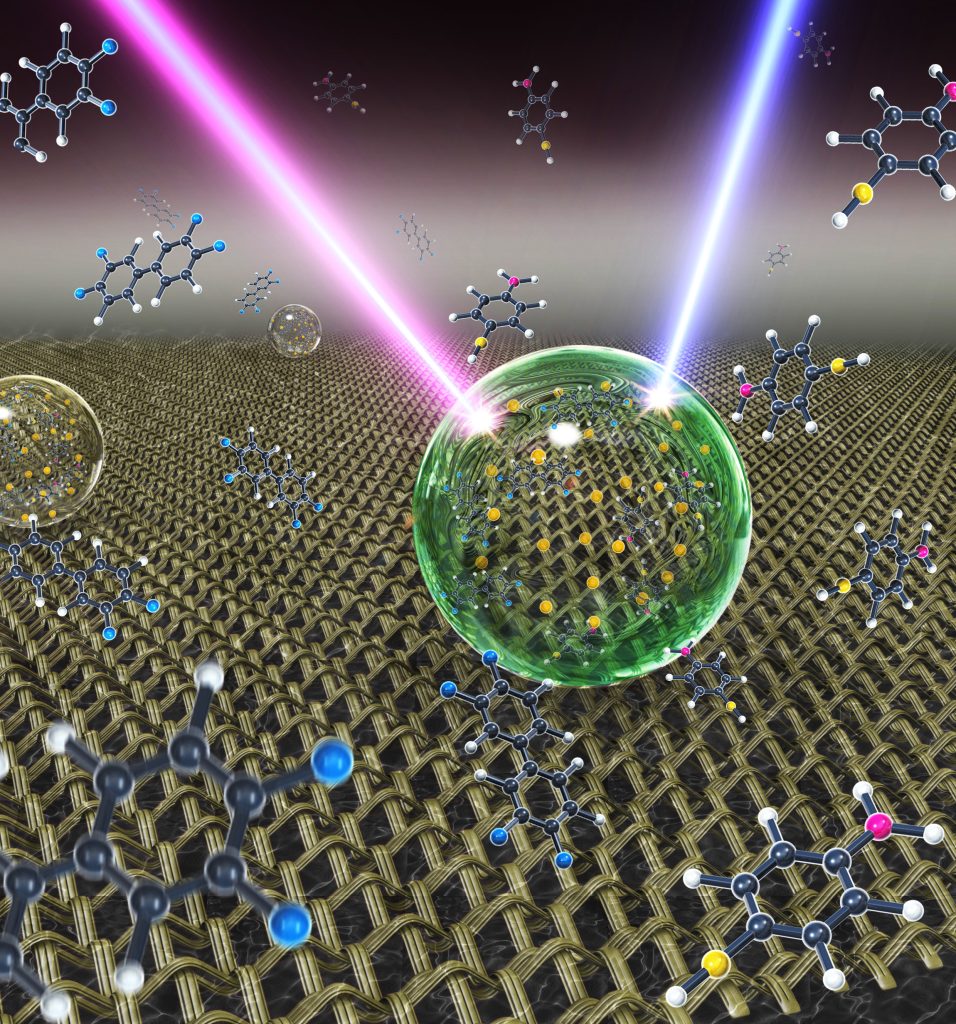
An artistic illustration showing an ultrasensitive detection platform called SLIPSERS — slippery liquid infused porous surface-enhanced Raman scattering. An aqueous or oil droplet containing gold nanoparticles and captured analytes is allowed to evaporate on a slippery substrate, leading to the formation of a highly compact nanoparticle aggregate for surface enhanced Raman scattering detection.
Researchers at Penn State have developed a new technique that combines the ultrasensitivity of surface-enhanced Raman scattering (SERS) with a slippery surface. The technique will make it feasible to detect single molecules from a number of chemical and biological species, whether gaseous, liquid or solid. This combination of slippery surface and laser-based spectroscopy will open new applications in analytical chemistry, molecular diagnostics, environmental monitoring and national security.
The research was funded by a U.S. National Science Foundation Faculty Early Career Development (CAREER) program award (grant CMMI 1351462).
Jose is another valued technician at Genentech, contributing to the company’s cutting-edge work in biotechnology. Jose reflects on his journey into the field, the technical skills he has honed, and how his work impacts healthcare. He emphasizes the importance of teamwork and continuous learning in staying at the forefront of innovation.
Show Notes
Jose works at Genentech. Jose grew up in the Bay Area and went from working in restaurants to a career in biotechnology. Hear about how Jose enrolled in a community college program, completed an internship and now has a career at one of the biggest biotech companies. Jose talks about what he is most passionate about at work and how you can work towards your dream career too.
The Talking Technicians podcast is produced by MNT-EC, the Micro Nano Technology Education Center, through financial support from the National Science Foundation’s Advanced Technological Education grant program.
Opinions expressed on this podcast do not necessarily represent those of the National Science Foundation.
Join the conversation. If you are a working technician or know someone who is, reach out to us at info@talkingtechnicians.org.
Sofia works at Genentech, where she plays a key role in advancing biotechnological innovations. In this episode, Sofia shares how her technical expertise supports groundbreaking healthcare solutions and the collaborative processes involved in her work. She discusses the challenges of working in a fast-paced industry and the satisfaction of contributing to life-changing treatments.
Show Notes
Sofia is a Lab Services and Media Prep Technician at Genetech. Hear how Sophia went from a degree in world languages to a community college biotech program. Sophia shares her story and journey in this episode and has advice for folks who want to transition careers and start work as a technician.
The Talking Technicians podcast is produced by MNT-EC, the Micro Nano Technology Education Center, through financial support from the National Science Foundation’s Advanced Technological Education grant program.
Opinions expressed on this podcast do not necessarily represent those of the National Science Foundation.
Join the conversation. If you are a working technician or know someone who is, reach out to us at info@talkingtechnicians.org.
Women have changed the world and continue to do so.
Some of you may think it was only men who did so, but that would be both inaccurate, and quite limited (one might also say foolish).
When we posted to honor Black History Month (with a bunch of great resources and links), we included a special mention about a Women’s History Month opportunity from the National Nanotechnology Coordination Office (NNCO) – Invite a Scientist to Class. If you are a technician or scientist working in the micro or nano fields, please get in touch with NNCO for future chances to share your passion and expertise with young people. We discovered that we needed a new dedicated post to share all the resources.
In honor of Women’s History Month, here is a big list of resources that can help you plan a lesson or activity that will open up the minds and hearts of your students. Not all of these resources are science or STEM-focused, but every resource here showcases how women continue to impact our lives in all ways.
Mildred Dresselhaus is known as the “Queen of Carbon Science.” She made pioneering contributions to the study of carbon materials, including carbon nanotubes. She was the first woman to receive the National Medal of Science in Engineering, and was awarded the Kavli Prize in Nanoscience in 2012.
This National Endowment for the Humanities series called Unladylike is powerful and profound. Their site, EDSITEment has specific science-oriented ones, but the entire 26 part series of animated documentary shorts about UNLADYLIKE2020’s trailblazing heroines is spectacular. They have a dedicated page here where you can scroll through to see each profile, briefly summarized. You can also watch it here on the American Masters YouTube channel (it has 31 videos).
Provides resources and support for women in science, including nanotechnology, including career development resources, networking opportunities, and information on issues facing women in STEM.
National Girls Collaborative Project: This project is dedicated to increasing the participation of girls in STEM fields, including nanotechnology. Its website provides resources and information for educators and parents, as well as a directory of programs and organizations dedicated to supporting girls in STEM.
Women in Technology International: This organization provides resources and support for women in technology fields, including nanotechnology. Its website features articles, webinars, and events related to career development and networking opportunities.
UN Women: This website is the official website of the United Nations entity dedicated to gender equality and the empowerment of women. It offers news, resources, and information related to women’s rights and gender equality around the world.
The Committee serves as a forum for women in chemistry and related professions, and works to increase and improve participation of women in the chemical sciences.
Smithsonian American Women’s History Initiative: This initiative aims to “amplify women’s voices, reach new audiences, and empower future generations” through research, exhibitions, and educational programs. The website features online exhibitions, collections, and resources related to women’s history.
This government agency provides a wealth of information and resources on nanotechnology, including an education and outreach section with lesson plans and educational resources for K-12 and undergraduate students.
This site provides resources and information on women’s history, including biographies, videos, and interactive activities. This page offers lesson plans for teachers.
This museum is dedicated to preserving and celebrating the history of women in the United States and provides a wealth of online resources and exhibits.
Vacuum systems are essential to various industries, and technicians who can maintain, troubleshoot, and repair them are highly valued. Excellent resources to help them learn and prepare for working with vacuum systems are hard to find. A team of three authors, with a savvy proposal, kept one of these resources alive.
The original author David Hata, Dr. Elena Brewer from Erie Community College (Williamsville, NY), and Nancy Louwagie from Normandale Community College (Bloomington, MN) submitted a proposal to the National Science Foundation Advanced Technological Education (NSF-ATE) program in consideration of a project which would convert Hata’s textbook to an e-book version.
Click the title to read the new, free E-book, Introduction to Vacuum Technology, from authors: David M. Hata; Elena V. Brewer; and Nancy J. Louwagie.
David Hata’s textbook, Introduction to Vacuum Technology, was first published in 2008, but discontinued in 2019. Without the work of these three, this textbook would be forever out of print.
Figure_3_9 _Vacuum Technology Ebook _Photo by Dr. Elena Brewer, SUNY Erie Community College
The textbook is suitable for community college-level technician courses. It covers rough and high vacuum systems, leak detection, and residual gas analysis, and includes laboratory exercises. In addition to the exercises, there are plenty of helpful photos and short quizzes at the end of each chapter. The authors focused on the needs of technicians in a production environment and is the result of years of teaching and learning with community college students.
Introduction to Vacuum Technology Chapter QuizExample