Abstract
Many two-year colleges (2YC) in the United States have never submitted a federal grant proposal. Project Vision (PV), an NSF-funded project that ran from May 2020 through April 2026, worked at the stage most mentoring programs skip, institutional alignment and presidential engagement, before proposal writing began. This work was done with five cohorts, 28 states, and 73 colleges. Fifty-eight of them had no NSF proposal history in the prior decade. Over the life of the project, 48 mentee colleges submitted ATE grant proposals. Twenty‑three of them received awards, and 19 chose to submit again. After analyzing multiple data sources, the team determined that four factors drove the results: 1) Ideation embedded in an institutional strategy before proposal writing. 2) Treating presidential mentorship as a culture change mechanism, not a formality. 3) Front-end preparation needs to be kept functionally separate from proposal development. 4) A connector function, not anticipated by PV at the outset, but which ended up extending the approach into other federal funding sources in year 6. This work demonstrates that a primary driver, institutional readiness and alignment, can be intentionally developed in a short period of time and help many 2YCs find a path to sustainable funding.
Keywords: grant active cultures, two-year colleges, NSF ATE, presidential engagement, mentorship, ideation, front-end mentoring, workforce development
© 2026 under the terms of the J ATE Open Access Publishing Agreement
Introduction
The NSF Advanced Technological Education (ATE) program has been supporting two-year college (2YC) technician education for over 30 years [1]. However, when we break down the numbers, we get a more complicated story. Between 2014 and 2023, proposals to NSF’s Directorate of Undergraduate Education (DUE) dropped about 20%, from 48,197 to 38,341, and 2YC proposals fell from 324 to 267 [2]. We use this window because it is the most recent stretch with complete, public proposal data; the 2024–2025 figures are not final yet and reflect agency changes unrelated to what we discuss here.
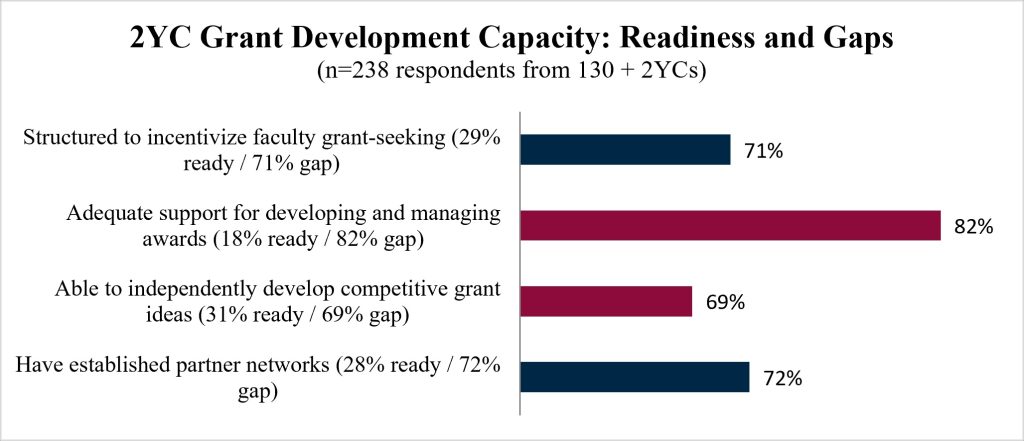
Federal grant applications are complex, faculty capacity is thin, and institutional demands crowd out grant development. None of this is news to anyone working in 2YCs [3, 4]. What we are seeing as more stubborn is the cultural and experiential gap. These gaps show up in technical expertise in producing competitive submissions [3], [5], [6], prior federal exposure, and internal incentive structures that make grant-seeking part of the 2YC faculty’s role. 2YC faculty are typically hired to teach, with reward and compensation systems that support this [5], [7], [8]. PV’s 2020 national survey of 238 respondents at more than 130 2YCs put numbers on the capacity picture: 71% reported their college was not structured to incentivize faculty grant seeking; 82% needed more support developing and implementing awards; 69% needed help just getting a grant idea together; 72% needed help finding partners [9] (Fig.1). Those numbers cluster around ideation, partnerships, and incentives. These issues are roughly what PV was designed to address. There is also a wrinkle in the same data worth noting: new awards to 2YCs rose from 69 in 2014 to 128 in 2023, an 85.5% jump, while overall submissions fell [2]. Colleges that get into the system appear to compete reasonably well. The harder problem, and the one that gets comparatively less attention, seems to be getting institutions to the application stage at all, rather than coaching them once they are already writing.
MentorLinks, Mentor-Connect, ATE-2YC, and PSEY2C have made breakthroughs in proposal writing and technical assistance [1], [10], and they reach colleges that are already in motion, institutions with prior NSF experience, some internal capacity, and someone who already knows what ATE is. A college with no grant infrastructure at all, led by a president who has never navigated federal funding, stays largely outside these pathways. Simply providing basic resources, such as a checklist or a stand-alone proposal workshop, will not create the sustainable structures needed to support grant involvement.
NSF Award #2018198 funded Project Vision (PV) from May 2020 through April 2026. Rather than starting with proposals, PV created a front-end intervention that started with presidents, before any grant concept had taken shape, before anyone had written a word. Leadership, administrators, and faculty worked through ideation and alignment first, building the foundation that most of these colleges never had the chance to build on their own. Over PV’s six years, across five cohorts, 73 2YCs from 28 states went through that process. Alongside its mentoring role, PV served as a national teaming partner: connecting colleges to ATE opportunities, industry expertise, academic content, Department of Energy (DOE) priorities, and the wider NSF ecosystem.
Four elements seem to explain what worked. However, calling these elements “mechanisms” gives them more theoretical tidiness than the data actually warrants. In this model, ideation happened before any proposal work began; that is probably the most important feature. Presidential engagement ran deeper than one-on-one advising. When this engagement took hold, grant-seeking operated more like an institutional-culture process than a discrete activity. We also learned that it was critical to keep the front-end preparation structurally separate from proposal development. This approach was partly by design and partly due to the accountability issues that bundling created. Additionally, PV developed a national teaming function we had not fully planned for, which eventually extended the work into DOE territory. This analysis draws on six years of external evaluation data, showcasing the success of this work. These findings point to a structural barrier. Without institutional alignment and leadership engagement, a significant portion of two-year colleges will struggle to participate in federal funding programs regardless of how much support they receive in proposal development. Addressing this front-end gap is foundational to broadening participation in these opportunities.
Two terms recur throughout this paper: institutional alignment and grant culture (or grant-active culture), and we use them in specific senses. Institutional alignment is the degree to which a college’s leadership, faculty, and strategic priorities converge on a shared, fundable direction before proposal writing begins, what Weiner frames as organizational readiness, a shared resolve and capability to act [11], [JP1] and what Cohen and Levinthal describe as absorptive capacity, the ability to recognize and put external resources to use [12]. By grant culture, a “grant-active” college, we mean the norms, structures, and capabilities that make grant-seeking a sustained, shared institutional activity rather than a one-off or single-person effort. PV operationalized these concepts through the pre- and post-mentorship ADKAR measures reported below, particularly the reinforcement dimension that tracks the structures sustaining grant-seeking.
Project Vision: Background and Context
PV was built for a college type that most mentoring programs never find. Small, rural, and often led by presidents who have not held an executive role. Many of these colleges have no established grants office, and faculty are stretched thin across teaching loads. These are not institutions that got missed by chance. The pathway into ATE was never built with them in mind. Additionally, even when they do appear on the mentoring program’s outreach list, they are not likely ready to develop proposals. What they need comes earlier in the process. It includes alignment work, a basic grasp of what federal grant funding is intended to do, and some clarity about institutional direction before anyone starts talking about a specific program.
The PV team included former college presidents and CEOs, senior administrators, academic deans, and former NSF program officers; no single role defined it. In practice, that mix mattered more than any one person’s title. Conversations could happen at the presidential, dean, and faculty levels simultaneously without losing the thread because someone on the team had actually held each of those roles. Fluency in the ATE ecosystem also meant PV could steer colleges to a specific center or partner, rather than just handing over a list of options. Whether other organizations can replicate this model will depend on their ability to bring together a team with a similar spread of experience, which is not a given.
PV’s six objectives organized the work with intentionally mapped steps that supported capacity building. 1) Recruiting rural colleges and colleges with newer presidents. 2) Structured ideation and institutional alignment. 3) Presidential engagement and the development of a grant culture. 4) Ecosystem connections. 5) Board of Education-level mentoring on federal funding. 6) Evaluation and dissemination. The sequence was as important as the list. Proposal development was done last, only after the alignment work had built something for it to land on. Most of these colleges had never had that foundation before, which is why leading with proposals had failed them before PV arrived.
Taken together, these components form a replicable framework for engaging new-to-grant institutions. We refer to this as a Front-End Institutional Alignment Model (FIAM). The model consists of four elements. (1) Presidential engagement as an entry condition, (2) structured ideation aligned with institutional strategy, (3) separation of front-end development from proposal writing, and (4) a connector function linking colleges to external expertise and funding pathways. This model provides a structured approach to building institutional readiness prior to proposal development.
Methods
This paper describes Project Vision’s design and outcomes, not a controlled research study. Throughout, we describe what PV did and what changed. These findings are about the participating PV colleges, not all 2YCs. We also acknowledge where further study may be needed.
Impact Allies ran PV’s external evaluation across six years and five cohorts using a mixed formative and summative design [13], [14]. [JP2] Continuous program improvement was one purpose; measuring PV’s progress against its stated goals was another. Documenting what actually changed for presidents, administrators, faculty, industry partners, and the NSF ATE ecosystem proved the hardest of the three to pin down.
Throughout the project, the PV team used pre‑, mid‑, and post‑mentorship surveys to track how faculty, administrators, and grant support staff understood their work over time. Additionally, the team engaged with mentee colleges by hosting monthly open office hours and topic‑specific calls or virtual meetings. These calls focused on areas such as lasers and photonics, advanced manufacturing, agriscience, cybersecurity, and energy systems, which added qualitative detail as cohorts moved through the process. Project documentation from the Pis, Co-PIs, SMEs, and the Project Manager rounded out the record, along with mentee colleges’ proposal panel reviews and a five-part professional development webinar series. A national survey of over 130 2YCs examined barriers and facilitators to grant activity [9]. From Year 3 onward, the PV team implemented a co-developed cluster algorithm through the Grant Insights for Research and Development (GIRD) project. This tool supported the team in analyzing more than 3,000 institutional variables, which helped with recruitment by surfacing colleges with grant-engagement potential but limited prior NSF participation [15].[JP3]
Measurement was centered around three questions. 1) Did PV meet its goals? 2) What actually changed at mentee institutions? 3) What did the work mean for the NSF ATE ecosystem? The independent evaluation team conducted a thematic analysis of the qualitative data to track progress and inform a regression analysis of predictors of sustained grant activity. This team worked with the findings throughout, and the PI team used the evidence for continuous improvement as it was gathered and analyzed. For post-mentorship surveys, we used the ADKAR framework, Awareness, Desire, Knowledge, Ability, and Reinforcement, as a lens on institutional change. Cohort 1 results (n=15, 60% response rate, 8 colleges) showed movement across all five dimensions.
- Awareness of reasons to pursue NSF ATE funding jumped from 27% to 76%.
- The desire to pursue ATE opportunities increased from 52% to 88%. Knowledge and ability to develop competitive proposals went from 48% to 75%.
- Institutional reinforcement (the structures that sustain grant-seeking over time) rose from 52% to 80% [16].
Worth noting: only 53% of the national survey sample rated prior grant experiences positively, compared to 93% of Cohort 1 participants who said the same about PV [9, 15, 16]. That gap told us something about the approach, and Cohort 1 gave us the baseline.
As we neared the end of the project, we conducted follow-up conversations in 2025 and 2026 with four mentee colleges: Wenatchee Valley College (WA), SUNY Corning (NY), SUNY Ulster (NY), and Northern Virginia Community College (NOVA). While these interviews provided valuable feedback for the PI team, they were not IRB-governed research interviews, but rather, ongoing program documentation. This documentation was treated as contextual evidence rather than independent primary data. Each of the four conversations brought distinct regional contexts, technical program areas, and levels of prior experience with grants. These conversations between PV Mentors and the college teams kept returning to three themes. 1) What in the PV process had actually mattered. 2) How institutional thinking about external funding had shifted. 3) What lasting change could the college point to?
Since there were only four interviews, the results of those interviews were reviewed thematically rather than under a formal coding protocol, consistent with its role as program documentation. The team grouped recurring topics into themes and kept those that appeared across more than one college; the Objective 2 themes (Table 2) were identified this way.
Results
Objective 1: Strategic Recruitment, Reaching New-to-ATE Colleges
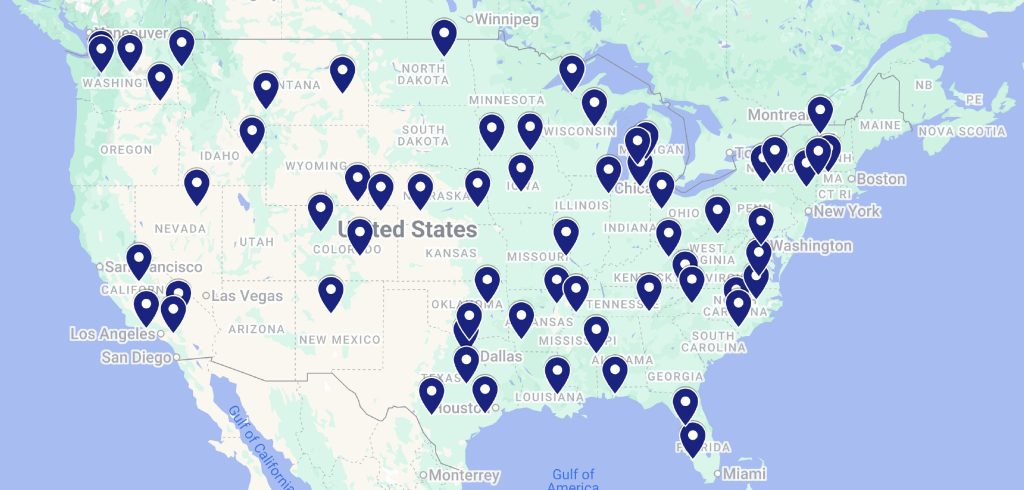
Overall, PV set out to work with 45 colleges. By the end of the project, 73 colleges across 28 states, over five cohorts, had participated (Fig. 2). Which colleges mattered as much as how many. Fifty-eight institutions had not submitted NSF proposals in the prior seven to ten years; more than half of Cohort 5 fit that description. Fifty-six were rural. Presidents at 57 colleges were in their first executive role. Table 1 breaks down the picture cohort by cohort. These were not institutions hovering on the edge of engagement. Rather, they were colleges that the NSF ecosystem was not structured to reach. Using the GIRD algorithm and other outreach strategies, PV reached colleges that other recruitment pathways had not, and it did so repeatedly across cohorts [15]. This suggests that a targeted capacity‑building model can bring entirely new institutions into the NSF pipeline, even if we still do not know how far that approach can be scaled.
Table 1. Cohort participation summary and key institutional characteristics
| Cohort 1 | Cohort 2 | Cohort 3 | Cohort 4 | Cohort 5 | |
| # 2YCs Mentored | 12 (target: 5) | 13 (target: 10) | 13 (target: 10) | 19 (target: 10) | 16 (target: 10) |
| # New to ATE | 9 | 9 | 11 | 17 | 12 |
| # FTE < 4,000 | 8 | 12 | 9 | 12 | 10 |
| # Rural | 7 | 12 | 10 | 15 | 12 |
| # Presidents < 2 yrs / 1st Presidency | 6 / 10 | 8 / 10 | 6 / 9 | 4 / 13 | 9 / 15 |
Early in this work, college recruitment was conducted through informal presidential networks, rural college alliances, and AACC connections. Starting in Year 3, the team utilized a co-developed cluster algorithm (GIRD) [15] that analyzed more than 3,000 institutional variables to identify colleges statistically similar to funded peer colleges but not yet active with NSF grants. These colleges would have been difficult to identify without this analysis tool. As a result of this outreach, 40 colleges applied to Cohort 5, while 16 received full PV engagement; the remaining 24 were referred to Mentor-Connect, Mentor Up, and relevant ATE Centers rather than being turned away.
Objective 2: Structured Ideation and Alignment
PV’s ideation process typically engaged colleges for six months or more before any proposal writing started. The work with a college began with a pre-visit institutional packet. Faculty and industry survey calls followed this, then three to five strategic sessions, culminating in a written alignment report that names a viable first grant direction. No template was handed over. Figuring out what the college was actually trying to build, and whether a grant was even the right instrument for it, that was the work.
When we asked them what aspect of PV mattered most, mentee colleges often talked about the ideation phase. At Wenatchee Valley College, the coordinator said, “For me, being a grants office of one, the most impactful part was probably the very beginning” (Wenatchee Valley College, March 2026).
At SUNY Ulster, what stood out was working next to content experts during ideation. “For [the] PI, it was in the ideation process that she realized how helpful it was to have experts to work with” (SUNY Ulster, 2025). On the other hand, moving SUNY Corning into the ATE ecosystem took a peer presidential introduction from PV leadership. The team called that moment a “turning point” in their grants culture (SUNY Corning, 2025). Across the four follow-up colleges, several themes recurred. Table 2 summarizes them with representative quotes.
Table 2. Recurring themes from end-of-project college interviews, with representative quotes (n = 4 colleges)
| Theme | Representative quote | Colleges |
| Early ideation was the most impactful phase | “…the most impactful part was probably the very beginning.” | Wenatchee Valley College; SUNY Ulster |
| Working alongside content experts mattered. | “…it was in the ideation process that she realized how helpful it was to have experts to work with.” | SUNY Ulster |
| A presidential introduction was the turning point | A “turning point”; without it, they “probably would not have considered… NSF funding… and ATE in particular.” | SUNY Corning |
| Access to a national network opened opportunities | Being connected to “a different national cohort” let faculty “learn more about growth opportunities… they might not have discovered otherwise.” | NOVA; SUNY Ulster; SUNY Corning |
| The work built lasting internal capacity. | A full-time grants coordinator and later awards (CAMP, TRIO, HRSA, USDA) after one PV engagement. | Wenatchee Valley College |
Not every ideation process pointed toward ATE. When structured alignment work pointed elsewhere, PV followed, connecting colleges to NSF TIP, NSF S-STEM, Department of Energy workforce initiatives, NASA programs, or state workforce development opportunities, six proposals outside ATE entirely in Year 6. The model does not require NSF; it works wherever a college needs to determine its goals and what it is actually trying to build.
In Year 6, the PV team launched an AI-guided ideation and alignment tool. This tool draws on regional workforce data, existing college programs, and each college’s strategic direction to find fundable project concepts grounded in the local context. Tool development was built and tested in stages. The tool was first tested through internal simulations against historical PV cohort data, to check that its outputs reproduced the kinds of project concepts and alignment frames PV mentors had previously arrived at through in-person work. It then moved into field sampling with partner community colleges already engaged with PV, where mentors used it alongside their existing ideation process. The tool is now publicly accessible through the Project Vision website and is being introduced to mentor groups, ATE Centers, and 2YC leadership groups through structured training. Whether it can preserve the effectiveness of the in-person process when used outside intensive mentoring, and whether it can meaningfully reduce time and cost barriers for colleges with limited internal capacity, are questions the current deployment is meant to help answer. Independent evaluation of those effects has not yet been conducted [17].
Objective 3: Engaging Presidents and Grant Culture Development
With more than 100 meetings with presidents and senior administrators in Year 6 alone, we demonstrated how PV treated presidential engagement as a prerequisite for deep ideation. This engagement was not just a formality. Each of those conversations was working toward the same thing and helping the president to see how a federal grant connected to where the institution was already headed strategically and operationally. That way, by the time a proposal took shape, the rationale was genuinely theirs.
At SUNY Ulster, a new president brought the ATE program to a meeting with the SUNY Chancellor, making it an institutional priority. At SUNY Corning, the entire PV engagement traced back to a peer-to-peer introduction from the president. Without it, the college said they “probably would not have considered the idea of NSF funding in general and ATE in particular” (SUNY Corning, 2025).
A new president had made establishing a grants office an institutional goal. PV arrived at Wenatchee Valley College at exactly that moment. The successful NSF proposal showed faculty it could be done. “Now that faculty have seen [a colleague] successfully receive a federal grant, there has been more interest. And I have had more faculty come to me looking for grant funding opportunities” (Wenatchee Valley College, March 2026). Wenatchee now has a full-time grants coordinator and has since received awards from the Department of Education (CAMP and TRIO), HRSA, and USDA. One engagement, one institution, multiple agencies over time, that is the arc. Table 3 summarizes ATE proposal activity and outcomes across cohorts.
Table 3. ATE proposal activity and outcomes PV by cohort
| Cohort 1 | Cohort 2 | Cohort 3 | Cohort 4 | Cohort 5 | |
| # ATE Submissions | 10 | 9 | 10 | 12 | 7 |
| # Favorable Reviews / Funded | 5 | 5 | 7 | 6 | TBD 2026 |
Forty-eight institutions submitted ATE proposals across all cohorts; 23 received funding, with 7 Cohort 5 determinations still pending. Nineteen submitted more than one NSF proposal, and more than 20% of colleges with no prior NSF history came back for a second round. Returning to submit again is what distinguishes a changed institution from a one-time participant [18].
Objective 4: Building Ecosystem Connections and National Teaming
One of our key findings was that proposal counts alone do not capture PV’s most distinctive contribution to the ATE ecosystem. Over time, PV grew into a national teaming role, using the experience of its SMEs to connect colleges to expertise they did not have in‑house. Many small and rural colleges cannot easily build bench strength in areas like energy systems, cybersecurity, or AI‑enabled infrastructure; they lack strong employer ties, internal curriculum resources, and sometimes even a clear sense that the needed expertise exists elsewhere and is reachable. In those cases, PV’s job was to close the gap by linking colleges to specific ATE Centers, industry partners, and other federal efforts, instead of leaving them to hunt for partners on their own.
Energy infrastructure, advanced manufacturing, cybersecurity, AI and data systems, electrification, transportation technologies, Cohort 5 project topics ran straight through the fields where national workforce demand is high, and 2YC capacity is thin [19]. Connecting those colleges to ATE Centers with deep domain expertise accelerated both program quality and proposal competitiveness.
Forty-four institutions got more involved with ATE through introductions made by PV. A connection to LASER-TEC, for example, gave SUNY Corning access to a curriculum repository that the college then adapted for its new optics program (SUNY Corning, 2025). At SUNY Ulster, the PI used PV’s network to reach Central Carolina Community College’s environmental and water program and bring in math preparation resources (SUNY Ulster, 2025).
Before Northern Virginia Community College received any funding, PV got NOVA faculty to the NSF ATE PI Conference. Networks and opportunities they had not known existed suddenly became visible, being connected to “a different national cohort” let faculty “learn more about growth opportunities for their program and institution that they might not have discovered otherwise” (Northern Virginia Community College, 2025). Attending a major conference before you have received your first grant is not how it usually happens.
Year 6 pushed past NSF ATE. Using the same front-end approach, PV helped mentee colleges engage with Department of Energy (DOE) workforce initiatives, including the Energy Improvements in Rural or Remote Areas (ERA) program. The DOE proposals were not written by PV; the team just supported the colleges to sharpen the idea, line it up with DOE’s priorities, and find a realistic funding path. The front-end process did not need to be agency-specific to work; the core question, figuring out what a college is trying to build and whether a grant is the right instrument, turned out to be the same conversation regardless of which federal door it eventually pointed toward. Whether that holds when PV is not in the room is still an open question.
Discussion
Early-stage Ideation and Presidential Mentorship: Primary Drivers of Grant Culture
Across cohorts, the colleges that did the early ideation and alignment work tended to stay engaged with federal funding, and the ones that skipped it usually did not. Over time, we stopped seeing that early work as merely helpful and started treating it as necessary. This lines up with Weiner, who argues that resolve and capability need to be in place before implementation [11], though readiness did not always translate into outcomes for us. Cohen and Levinthal make a related point: institutions with a thin internal knowledge base are less able to absorb outside expertise [12]. We saw exactly that when colleges began writing proposals before their leaders had agreed on a direction. In cases that worked, presidents and faculty spent time wrestling with the project idea and tying it to the college’s existing priorities before moving ahead. That early work appeared to create a lasting alignment, rather than the more fragile agreement we saw when alignment was put together later in the process. What is being built at that stage, and whether it is the same phenomenon across institutions, remain unclear, and attempts to measure it have not yet been satisfactory.
Multi-level institutional support is a reliable predictor of sustained external funding at 2YCs in the literature [3], [20], [21], and longitudinal work suggests that front-end planning support matters more over multi-year windows than downstream proposal training [22]. However, we would note that those findings are not always easy to compare across studies. A ten-site NIH BUILD study found institutional priority alignment at inception out-predicted downstream factors [23], which is consistent with what we saw, if not quite the same thing. In retrospect, proposal counts and dollar totals did not tell us much about which institutions were building a process and culture that would last. Rather, a better signal was whether the work had spread. Indicators of this included active engagement of administrators and faculty beyond the lead PI. When this engagement was not present, we saw examples of one person carrying almost everything, and when that person left, the grant culture often left with them. This happened more than once, and sometimes the grant culture recovered, but often it did not.
In our review of the literature, pre-proposal ideation as a distinct operational stage has not received much empirical attention at scale. Practitioner guides mention ideation only briefly, and Preuss’s grant-readiness work is helpful but addresses a different question [24]. Organizational readiness theory also explains why an early stage like this should matter [11], [12]. None of these, however, provides an empirical record of structured ideation used as a deliberate intervention over multiple years and cohorts with outcomes tracked for the same institutions. PV’s six-year, five-cohort dataset covering 73 institutions represents one of the most comprehensive multi-cohort examinations of structured front-end ideation in two-year colleges to date. Work we did not find may exist. And this data set carries methodological constraints we have not fully worked through, some of which are significant enough that we would push back on anyone who cited it too confidently.
Presidential Mentorship: The Mechanism for Sustainable Grant Culture
Presidential engagement was PV’s entry condition, not a courtesy or something added on later. Only 22% of eligible public 2YCs participate in NSF ATE [25], and PV’s working assumption, which the data mostly bore out, was that presidential awareness is the primary lever for closing that gap. PV found that when presidents took part in the early ideation, before any proposal development was underway, grant-seeking lined up with where the college was headed, instead of sitting on one faculty member’s desk. This embedded the strategy in the college, rather than a single person, and an approach that survives turnover [26], [27]. Four of 13 studies in a systematic review identified presidential commitment as a key facilitator and scholarly climate as a core determinant of outcomes [3]. None of that is surprising in retrospect. What took the PV team longer to learn was the difference between a supportive president and one who is genuinely engaged in the work. Over the work with five cohorts, we also learned that often those look identical from the outside until something goes sideways mid-engagement.
By Year 3, PV had learned to look for “the right PI with the right situation”. This person was often a high-performing faculty member inside an institution where administration was genuinely on board [28]. Presidents came first, before deep ideation, before significant faculty time was committed, precisely to lock that alignment in early. At SUNY Ulster, a new president arrived mid-engagement and, rather than slowing things down, took the ATE-supported program to the SUNY Chancellor. This approach leveraged one grant into an institution-wide signal that stressed the importance of grants. Presidential engagement matters a lot. Whether it is sufficient on its own is unclear. In SUNY Ulster’s case, it amplified everything; in other cases, we saw presidential interest that did not yield anything durable, and we have not yet fully worked out the difference, presenting an opportunity for further study.
Front-End Preparation and Handoffs: A Scalable Ecosystem Strategy
Partners who received PV handoffs quickly noticed whether an institution had completed the ideation work. The handoffs were supposed to deliver colleges that had worked through a project concept, aligned leadership, and started building infrastructure. Factors that would support them as they moved into proposal development, rather than still figuring out what they wanted to do. That worked reasonably often, but not always. Proposal work stalled for months at several handoff sites, not because the proposal partners did something wrong, but because the alignment PV was supposed to have built had never fully taken hold. We are fairly confident that it was a PV failure in those cases, though what specifically went wrong varied. Separating front-end work from proposal development did make those failure points easier to identify than they would have been in a bundled program, which is something. While coordination across organizations introduces complexity, separating front-end alignment from proposal development provides critical clarity for diagnosing institutional readiness.
National Teaming to Close Bench-Strength Gaps in Emerging Fields
Across six years and 73 institutions in 28 states, working with both NSF and DOE programs, we have looked for another intermediary doing this specific mix of work and have yet to find one. Studies of intermediary organizations show that bridging loosely connected stakeholders can build real capacity in education and workforce systems [29], [30], [31]. Burt’s work on structural holes also helps explain why actors that link otherwise separate networks often create outsized value [32]. However, given the evidence we have, six years in, PV looks less like a single project and more like a standing intermediary. It starts with presidents, does the alignment work before any proposal, and reaches across several federal agencies. We have not seen this combination described elsewhere. Whether the absence of this combination reflects a gap in practice or simply a gap in documentation is still unclear to us.
Conclusion
Six years in, PV looks less like a one-time mentoring project and more like a working model for building a ‘grant-active’ culture at two-year colleges. The same front-end approach, starting with presidents and doing the alignment work before any proposal, may carry beyond ATE to other colleges and other funders. We see that as a possibility worth testing, not something this project proves. While it was technically a mentoring program, the mentoring was in service of something most programs do not try to do. Creating the institutional conditions for grant activity to continue after PV leaves. We saw the same thing again and again across five cohorts and 73 colleges. When presidents were genuinely involved, and teams did the ideation work before writing, colleges were much more likely to move from being interested in grants to actually pursuing and managing them. Our experience shows that when presidents were only nominally involved, or when teams skipped the ideation work, problems had a tendency to surface downstream in ways that were harder to fix.
As PV moved forward, we could see how the pieces fit and which ones mattered. Starting with presidents helped for a straightforward reason. When presidential support was real, later work had something solid to rest on. Structured ideation began as a front‑end quality check, but it also gave administrators and faculty a shared language to keep the rest of the process together and hold each other accountable. This was a benefit we could not describe until well into Year 3. Connections to ATE Centers, TIP projects, and proposal‑writing partners did not appear on their own, so by Year 4, we were building deliberate steps to make them. Any replication effort will need similar attention to ensure the approach applies to funders outside of ATE.
The largest gap identified in this work is what happens to grant-seeking at PV colleges over time. The project’s timeframe did not enable us to track proposal activity, capacity measures, or multi-agency funding five or ten years out. What we report here is a snapshot rather than a long-view picture. For now, front-end mentoring sits in the “promising practice” bucket rather than among approaches backed by long-term outcome evidence. Building that evidence will require follow-up studies that stay with institutions well beyond an initial mentoring cycle. The AI-guided ideation tool piloted in Year 6 is a related example of the beginning of that work. The tool has been validated against PV’s prior in-person process through simulation and field sampling, is publicly available, and is now being used by mentor groups, ATE Centers, and 2YC leadership groups. However, it has not been independently evaluated, and we do not yet know how its effects compare with the in-person process or whether it can extend the front-end alignment model to institutions that cannot access intensive in-person support. We offer it here as a working hypothesis that warrants further study, not as evidence that the model has been scaled.
Even with these limitations, the main conclusion still holds. PV shows that an intentional and explicit front-end intermediary role that emphasizes presidential engagement and provides a connector function to multiple federal and state funding streams can make all the difference in moving colleges that were off the map into “grant active” participation. Some colleges have already leveraged the foundation built through participation in PV to pursue grants well beyond ATE. Others have advanced more slowly, and there are a few we cannot yet account for. However, the overall trajectory is positive. For college presidents, deans, and grant leads, there is a simple takeaway. The time spent early on ideas, gaining leadership buy-in, and establishing the right connections is what makes later proposal development worth all the effort.
Acknowledgments. This work was supported by the National Science Foundation (NSF) under Award #2018198. The authors thank the Project Vision PI team (Dr. Kevin Cooper, Dr. David Brown, Dr. Rassoul Dastmozd), project manager Shannon Wood, coordinator Jennifer Neubauer, and all mentee college presidents, administrators, faculty, and staff who took part in the project.
Disclosures. No conflicts of interest exist among the authors. Artificial intelligence (AI) writing assistance tools were used in preparing this manuscript. Claude (Anthropic) was used for drafting, structural editing, and synthesis support; Perplexity AI was used for literature discovery and source identification. All intellectual content, argument structure, data interpretation, analytical conclusions, and authorial decisions were made by the authors. The authors take full responsibility for the accuracy, integrity, and originality of the work as submitted.
[1] E. L. Craft, K. Wosczyna-Birch, and C. B. Forrest, “Gaining the competitive edge in proposal submission to the National Science Foundation Advanced Technological Education Program (NSF-ATE): Mentor-Connect,” in Proc. 2017 ASEE Annu. Conf. Expo., Columbus, OH, Jun. 2017, Paper ID 19110. [Online]. Available: https://peer.asee.org/gaining-the-competitive-edge-in-proposal-submission-to-the-national-science-foundation-advanced-technological-education-program-nsf-ate-mentor-connect
[2] National Science Foundation, “NSF by the Numbers,” NSF.gov, Washington, DC, 2025. [Online]. Available: https://tableau.external.nsf.gov/views/NSFbyNumbers/Trends (accessed Mar. 29, 2026).
[3] R. A. Goff-Albritton, P. A. Cola, J. Walker, S. D. Yerra, and I. Garcia, “Faculty views on the barriers and facilitators to grant activities in the USA: a systematic literature review,” J. Res. Admin., vol. 53, no. 2, pp. 14–39, 2022. [Online]. Available: https://eric.ed.gov/?id=EJ1362093
[4] E. Doran and S. Aguilar-Smith, “Money is not free: a systematic content analysis of Hispanic-serving community colleges Title V awardees proposals,” AERA Open, vol. 11, 2025, doi: 10.1177/23328584251321451.
[5] P. Renninger, A. Meilof, T. Pitts, and J. K. Smalley, “Why should community college faculty write grant proposals?” Community Coll. J. Res. Practice, vol. 31, no. 9, pp. 725–729, 2007.
[6] K. E. Mosier, “Deconstructing the art of grantsmanship: the roles of the storyteller, grant writer, typesetter, proofreader, accountant and reviewer,” J. Res. Admin., vol. 53, no. 1, pp. 93–121, Spring 2022. [Online]. Available: https://eric.ed.gov/?id=EJ1347989 (accessed Mar. 29, 2026).
[7] M. Mastronardi, D. R. Brown, M. Borrego, and J. Krupczak, “Capacity building workshop for two-year colleges seeking U.S. National Science Foundation funding,” Community Coll. J. Res. Practice, vol. 48, no. 12, pp. 745–757, 2024, doi: 10.1080/10668926.2023.2236039.
[8] A. S. Sehlaoui, E. Gross, and P. Ruengwatthakee, “Motivating factors and obstacles behind grant research: the case of a teaching focused state college,” J. Res. Admin., vol. 52, no. 1, pp. 38–58, Spring 2021. [Online]. Available: https://eric.ed.gov/?id=EJ1293036
[9] Project Vision, Project Vision’s Survey Results: Understanding Proposal Submissions from Two-Year Colleges, National Science Foundation, Award #2018198, n.d.
[10] R. Dastmozd, PV Handbook, NSF Project Vision, Award #2018198, Jun. 2020. [Online]. Available: https://projectvis.org/wp-content/uploads/2020/08/PV-Handbook-ADA.pdf
[11] B. J. Weiner, “A theory of organizational readiness for change,” Implement. Sci., vol. 4, no. 1, Art. no. 67, Oct. 2009, doi: 10.1186/1748-5908-4-67.
[12] W. M. Cohen and D. A. Levinthal, “Absorptive capacity: a new perspective on learning and innovation,” Admin. Sci. Q., vol. 35, no. 1, pp. 128–152, Mar. 1990, doi: 10.2307/2393553.
[13] B. Reid, External Evaluation Report: Project Vision’s 1st Year, a National Science Foundation (NSF) Advanced Technological Education (ATE) Supported Project (Award #2018198), Impact Allies, 2021.
[14] J. Frechtling, The 2010 User-Friendly Handbook for Project Evaluation, Westat/National Science Foundation, Washington, DC, 2010. [Online]. Available: https://evalu-ate.org/external-resource/doc-2010-nsfhandbook/ (accessed Mar. 29, 2026).
[15] B. Reid, S. Hodgson, K. Cooper, R. Dastmozd, and D. Brown, “Data, insights, and solutions to aid NSF ATE and 2-year colleges in creating and sustaining ‘grant active’ cultures,” J. Adv. Technol. Educ., vol. 3, no. 1, pp. 1–12, 2024, doi: 10.5281/zenodo.10971682.
[16] B. Reid, Project Vision’s Cohort 1 Post-Mentorship Survey Results, Impact Allies / Project Vision, Jan. 2022.
[17] K. Cooper, NSF Annual Report 2026: Broadening Institutional Participation in the NSF Advanced Technological Education Program (Award #2018198), Indian River State College, Mar. 2026.
[18] L. Gant, C. Velez, and M. Torres, “Measuring institutional capacity for grantsmanship: constructing a survey tool for institutions to assess institutional support for faculty and administrators to pursue grant funding,” J. Res. Admin., vol. 55, no. 2, pp. 70–88, 2024.
[19] C. Sublett and J. Tovar, “Community college career and technical education and labor market projections: a national study of alignment,” Community Coll. Rev., vol. 49, no. 2, pp. 177–201, Apr. 2021, doi: 10.1177/0091552120982008.
[20] S. G. Budd, “Community colleges and the pursuit of large grants: strategies for success,” Ed.D. dissertation, Dept. Educ., Univ. of Massachusetts Amherst, Amherst, MA, USA, 2011, doi: 10.7275/2174996.
[21] S. Oviedo, Y. Rodríguez, and M. Varelas, “Building a culture of grantsmanship at an urban community colleges via internal funding opportunities,” J. Res. Admin., vol. 56, no. 2, pp. 88–113, 2025. [Online]. Available: https://eric.ed.gov/?id=EJ1491695
[22] L. F. Huenneke, D. M. Stearns, J. D. Martinez, and K. Laurila, “Key strategies for building research capacity of university faculty members,” Innov. Higher Educ., vol. 42, no. 5–6, pp. 421–435, Dec. 2017, doi: 10.1007/s10755-017-9394-y.
[23] N. A. Stephen, K. P. Cobian, A. L. Romero, H. V. Ramos, and S. Hurtado, “Sustaining grant-funded programs: conditions for sustaining initiatives that enhance diversity in STEMM,” PLoS ONE, vol. 21, no. 2, Art. no. e0343368, Feb. 2026, doi: 10.1371/journal.pone.0343368.
[24] M. Preuss, “Assessing grant capacity and readiness: a systematic review of the periodical literature of research administration,” Res. Manage. Rev., vol. 20, no. 2, 2015. [Online]. Available: https://eric.ed.gov/?id=EJ1063996 (accessed Mar. 29, 2026).
[25] G. Boggs, “The community college presidents’ initiative in science, technology, engineering, and mathematics,” Educ. Considerations, vol. 50, no. 2, 2025, doi: 10.4148/0146-9282.2429.
[26] E. A. Smith, “A decade in review: a systematic literature review of presidential engagement in community college fundraising,” J. Res. Coll. Pres., vol. 5, no. 5, Dec. 2021, doi: 10.54119/jrcp.2021.504.
[27] Á. de J. González, E. Holcombe, and A. Kezar, “Systemic change at community colleges: highlighting leader moves of transformation,” New Dir. Community Coll., vol. 2025, no. 211, pp. 9–14, Feb. 2025, doi: 10.1002/cc.20657.
[28] B. Reid, K. Rotindo, and S. Hodgson, Project Vision 2026 External Evaluation Report, Impact Allies, Apr. 2026.
[29] M. I. Honig, “The new middle management: intermediary organizations in education policy implementation,” Educ. Eval. Policy Anal., vol. 26, no. 1, pp. 65–87, Spring 2004, doi: 10.3102/01623737026001065.
[30] B. Rechsteiner, E. Kyndt, M. Compagnoni, A. Wullschleger, and K. Maag Merki, “Bridging gaps: a systematic literature review of brokerage in educational change,” J. Educ. Change, vol. 25, no. 2, pp. 305–339, 2024, doi: 10.1007/s10833-023-09493-7.
[31] D. J. Weerts and L. R. Sandmann, “Community engagement and boundary-spanning roles at research universities,” J. Higher Educ., vol. 81, no. 6, pp. 632–657, Nov./Dec. 2010, doi: 10.1080/00221546.2010.11779075.
[32] R. S. Burt, “Structural holes and good ideas,” Amer. J. Sociol., vol. 110, no. 2, pp. 349–399, Sep. 2004, doi: 10.1086/421787.