Linzee transitioned from food preparation in a hospital to becoming a technician at Intel. She shares how community college education transformed her life, the skills she developed, and how anyone can take steps toward a fulfilling career as a technician.
Show Notes
Linzee is a technician at Intel in Hillsboro, Oregon. Linzee started working in food prep in a hospital then went to community college to become a technician. Hear how Linzee’s life changed when she became a technician and how you can become a technician too.
The Talking Technicians podcast is produced by MNT-EC, the Micro Nano Technology Education Center, through financial support from the National Science Foundation’s Advanced Technological Education grant program.
Opinions expressed on this podcast do not necessarily represent those of the National Science Foundation.
Join the conversation. If you are a working technician or know someone who is, reach out to us at info@talkingtechnicians.org.
“If our small minds, for some convenience, divide this universe into parts—physics, biology, geology, astronomy, psychology, and so on—remember that nature does not know it!“
—Richard Feynman (Shout out to the Twitter Account honoring Richard Feynman.)
Credit: Justin Burton, Emory University
In this new section, the Editor’s Corner, we will be sharing a curated list of articles, videos, and social feeds we find relevant or helpful to the MNT-EC mission of helping advance the micro nano technician workforce (you can read more about our mission and goals here).
Microelectronics
If you are an educator or workforce development specialist, this upcoming workshop on February 3 may interest you: The State University of New York (SUNY), Massachusetts Institute of Technology (MIT), and Rensselaer Polytechnic Institute (RPI) invite you to take part in a workshop focusing on current challenges in the education and workforce development pipeline for current and future microelectronics manufacturing and design in the U.S. Visit the MNT-EC Calendar for more info: Education and Workforce Development for U.S. Microelectronics Industry.
Social Media and Networking with Micro Nano professionals
Thanks to relatively recent materials science work scientists are finding ways to extract water from air with solar powered hydropanels.
According to Forbes, “An Arizona company, SOURCE, and its founder, Cody Friesen, a materials scientist and associate professor at Arizona State University, spent nearly seven years developing the Source Hydropanel… Pure water is mineralized with magnesium and calcium to achieve an ideal taste profile. Finally, sensors in each hydropanel monitor and optimize the water to maintain quality. The hydropanels produce an average of 3-5 liters of clean drinking water per day (or up to 1.3 gallons).”
Do-It-Yourself Microscope
Much of the micro nano world relies upon advanced microscopes. Although this simple, affordable, and fun microscope is far from advanced, it is elegant and it does make science accessible in important ways. The Foldscope is a do-it-yourself (DIY) type microscope, according to the website, Foldscope was “invented by Manu Prakash and Jim Cybulski who asked themselves: What is the best microscope you can build for under $1 in parts? Over 1.5 million of these can be found in the wild, in the hands of children, educators, and citizen scientists around the world — that’s a good thing.
Foldscope DIY Microscope website screenshot including Images taken with Foldscope
Two More Educator-related Resources
If you do not already know or follow Tom Vander Ark from Getting Smart, he recently posted about Trends Shaping Education in 2022. A worthwhile read that highlights important areas to watch, New Learning Goals including Diversity, Equity, and Inclusion (DEI); Team Tools and Staffing; and Active Learning.
Speaking of DEI-related content: The Underrepresentation Curriculum (URC) is a free, flexible curriculum for STEM instructors to teach about injustice and change the culture of STEM. Using tools such as data analysis, hypothesis creation, and investigation, students look critically at science through the lenses of equity and inclusion. By comparing the general population to similar data describing scientists, students can explore issues of social justice in STEM.
May your weekend be filled with many small things that make a difference.
More information about the first post image – although it is not specifically a nano or microtechnology image, I will claim Feynman’s quote – nature does not know about our divisions of courses and fields of study, so this work may influence an area of nanotechnology at some point in the future. More so, this curation effort will feature a wide range of science, technology, engineering, and math (STEM) topics that you may find spurs a new idea or direction in your research or classroom.
Water droplet levitates in the Leidenfrost state
A water droplet levitates 80 microns above a hot surface heated past water’s boiling point in the Leidenfrost state. [Research supported by U.S. National Science Foundation grant DMR 1455086.] Learn more in the Emory University news story New method reveals minimum heat for levitating drops.
An earlier post about Foldscope was published at Medium.
The world around us provides enormous opportunities for understanding science. Arguably, it has been one of humankind’s greatest inspirations for many, if not most, inventions, art, and other creations. Nature offers us specific nanotechnology lessons and is the subject of a new book from Morgan & Claypool Publishers. Nanotechnology: Lessons from Nature — Discoveries, Research, and Applications, by Deb Newberry of Newberry Technology Associates, will be published later this month.
Nanotechnology: Lessons from Nature — Discoveries, Research, and Applications, by Deb Newberry
This new book covers 21 different phenomena that have been observed in nature and puzzled about for decades. Diving into five ecosystems— the ocean, insects, flora, fauna, and humans — Newberry offers observations to help readers understand the relationship between the more easily observed macro level and understanding what is found at the nanoscale.
The book summary points out how “the development of microscopes and other tools allow us to study, evaluate, and test these observed phenomena at the molecular and atomic scale… From the strength of a marine sponge found at the depths of the oceans, to the insect-hydroplaning surface of the edge of a plant, to the intricacies of the eyes of a moth, nanotechnology has allowed science to define and understand these amazing capabilities. In many cases, this new understanding has been applied to products and applications that benefit humans and the environment.”
This book is for sale in the retail market on all major platforms and can be purchased directly from Morgan & Claypool Publishers here. It is also available to institutions with access to Synthesis Digital Library Collection 11 here. This is the second book they have published by Ms. Newberry, the first being titled Nanotechnology Past and Present: Leading to Science, Engineering, and Technology (2020).
Deb Newberry, Founder and CEO of Newberry Technology Associates, is a consultant to the MNT-EC. She has been involved with research, emerging technology, and nanotechnology for several decades. She served as the Director/Instructor of the Nanoscience Technician program at Dakota County Technical College in Rosemount MN from 2004–2018. She created the 72-credit nanoscience technician program in 2003 and began the program with National Science Foundation funding. Deb also served as the Director and Principal Investigator of the Center for Nanotechnology Education, Nano-Link, for 10-plus years with over $12M from the National Science Foundation.
If you want to learn more about how nature and nanotechnology go together, you can also check out the NNCI page: Nature Helps Technology. The National Nanotechnology Coordinated Infrastructure (NNCI), established in 2015, is supported by 16 individual cooperative agreements from the National Science Foundation. NNCI is also an Advanced Technological Education (ATE) Partner with MNT-EC.
Social media is a great way to keep up with the news. Well, mostly. Sometimes it can be a distraction, too. To make platforms like Twitter pay off, we are compiling a big list of the people (link at end of post) in Nanotechnology and Microtechnology (MicroNano) that you may want to follow to keep up with specific developments and trends.
Scroll through this list and then to the end for ways to contact us with your favorites.
The Story Collider @storycollider. True, personal stories about science. Podcast | Shows | Storytelling Workshops. Although this account is not MicroNano specific, it does offer some wonderful stories about science, scientists and their journeys.
nanoHUB @nanoHUBnews. Online simulation, research, collaboration, teaching, learning, and publishing. Free accounts, free access to over 6,500 resources including simulation tools. nanoHUB is also a partner here at MNT-EC.
NNI @NNInanonews Official Twitter feed for the U.S. National Nanotechnology Initiative. NNI is a MNT-EC partner.
Nature Nano @NatureNano. A journal that covers all aspects of nanoscale science and technology.
Nano Letters @NanoLetters. Fundamental research in all branches of the theory and practice of nanoscience and nanotechnology.
AZoNano @AZoNano. The latest nanotechnology news, applications, and equipment from some of the biggest companies in the nanotechnology industry.
Nanotechnology @Nanotechnology. Nanotechnology News as it Happens.
Students and Citizen Scientists using the Foldscope
Foldscope @TeamFoldscope. We are the makers of Foldscope, the original paper microscope! Working to globally expand access to microscopy & the wonder of science. I liked their main page image so much I had to include it here (just above the listing) — it is just terrific to see so many young scientists (and older “citizen scientists”) gaining access to observe a world so often unseen.
3D Printing Industry @3dprintindustry. Leading source for #3DPrinting news & information – industry reports, business directory, jobs board, and more. Editorial Note: This publication often includes news about how #nanotechnology and #3D intersect. Hat tip to Dr. Ismail Fidan at Tennessee Tech for reminding me about this terrific resource. You can check out two recent articles on Nanomagnets here and here.
SustainableNano @SustainableNano. Tweets of the NSF Center for Sustainable Nanotechnology: nanotech, sustainability, & life in science. (Opinions our own, etc.)
Institute for Nano-Engineered Systems @UWNanoES. Catalyzing innovative, interdisciplinary, & industry-relevant research in the fabrication & integration of scalable #nanotech@UW. Newsletter: http://bit.ly/2n45mQu
The National Nanomanufacturing Network (NNN) @nanomfgnet is an alliance of academic, government, and industry partners cooperating to advance nanomanufacturing in the US.
Get in Touch!
Feel free to reach out to TJ McCue on Twitter to share resources and people that we should consider for this post. He also maintains a Twitter list that you can follow: Top Nanotechnology Experts and Organizations on Twitter. If you were wondering where all the “people” were in this post, that list is growing too large to include here, so you can visit the Twitter list to find the rest.
Yeysen earned a two-year degree at Centralia College, paving the way to his career as a technician at Intel. Now earning over $50,000 annually, Yeysen highlights the importance of education and hard work in achieving financial and professional success in the tech industry.
Show Notes
Yeysen works as a technician at Intel in Hillsboro, Oregon. He graduated from Centralia College with a 2-year degree and now works in a field where he can make more than $50,000. Hear Yeysen’s story in this episode.
The Talking Technicians podcast is produced by MNT-EC, the Micro Nano Technology Education Center, through financial support from the National Science Foundation’s Advanced Technological Education grant program.
Opinions expressed on this podcast do not necessarily represent those of the National Science Foundation.
Join the conversation. If you are a working technician or know someone who is, reach out to us at info@talkingtechnicians.org.
Sam is a manufacturing technician at Intel near Phoenix, Arizona. After completing a two-year community college degree, Sam secured a role at one of the world’s leading tech companies. He discusses the skills and determination needed to succeed in semiconductor manufacturing.
Show Notes
Sam works as a manufacturing technician at Intel outside Phoenix, AZ. Sam went to a community college and graduated with a 2-year degree. Then he got a job at Intel. Hear Sam’s story in this episode.
The Talking Technicians podcast is produced by MNT-EC, the Micro Nano Technology Education Center, through financial support from the National Science Foundation’s Advanced Technological Education grant program.
Opinions expressed on this podcast do not necessarily represent those of the National Science Foundation.
Join the conversation. If you are a working technician or know someone who is, reach out to us at info@talkingtechnicians.org.
Rick Vaughn at Rio Salado College is encouraging Arizona residents to think small. Small as in nanotechnology size small. Smaller than you can see with the naked eye. Thanks to recent NSF (National Science Foundation) funding, the school is offering scholarships that will cover half the cost for a nanotechnology certificate.
With an above-average national median salary of $40,500, Nanotechnology and semiconductor technicians are in demand, according to the Bureau of Labor Statistics. If you are an Arizona resident, these scholarships are aimed at you.
If you are not an Arizona resident, visit the Nanotechnology Jobs – A Resource Guide that includes links to a variety of programs and statistics: “According to CareerExplorer.com, “there are currently an estimated 132,500 nanotechnology engineers in the United States. The nanotechnology engineer job market is expected to grow by 6.4% between 2016 and 2026.” The top states for Nanotechnology Engineer jobs are also listed in the post.
Read more about the Rio Salado College Nanotechnology Scholarships below:
“Nanotechnology embodies everything that has to do with engineering, chemistry, biology and science, and then puts them together with technology to form something that’s new and different,” said Dr. Rick Vaughn, Rio Salado College Faculty Chair for STEM initiatives.
According to the National Nanotechnology Initiative, nanotechnology touches many of us through a variety of consumer products such as eyeglasses, computer screens, cosmetics, clothes, digital storage, tires, paint, lasers and airplane coatings.
Rio Salado recently received a $300,000 grant from the National Science Foundation to train 30 students and help increase the employee pool for the nanotechnology industry. Rio Salado is offering five $780 scholarships that will cover half the cost of the 6-course nanotechnology certificate program.
Cristian began as an intern and now works full-time as a microscopy technician at Oak Crest Institute of Science. In this episode, Cristian shares his journey into the world of electron microscopy, his contributions to scientific research, and the value of internships in opening doors to high-tech careers.
Show Notes
Cristian works as a technician at the Oak Crest Institute of Science in Monrovia, CA. He started out as an intern and now works full-time as a microscopy technician. Hear Cristian’s story and learn about electron microscopy in this episode.
The Talking Technicians podcast is produced by MNT-EC, the Micro Nano Technology Education Center, through financial support from the National Science Foundation’s Advanced Technological Education grant program.
Opinions expressed on this podcast do not necessarily represent those of the National Science Foundation.
Join the conversation. If you are a working technician or know someone who is, reach out to us at info@talkingtechnicians.org.
Whether you are a student, the parent of one, an educator, or an interested citizen scientist, the Micro Nano Technology Education Center (MNT-EC) YouTube channel is a place where you can learn more about microtechnology, nanotechnology, photonics, military veteran programs, and even what NASA is doing in its education and outreach efforts.
Active Duty service members Working with Transition Assistance Programs with Kate Alcott:
Future post coming on U.S. Military and Veteran certificate and degree program efforts leading to great jobs in Nanotechnology and Microtechnology across the country.
Nano Health and Safety Workshop
MNT-EC and Mentor-Connect
Kendrick Davis – State of STEM education
Neda Habibi – Nanotechnology and Advanced Materials Technology
Bob Ehrman & Ozgar Cakmak – Penn State CNEU – It’s NACK plus more
Peter Kazarinoff – MNT-EC Podcast and Journal
Kate Alcott – Active Duty service members Working with Transition Assistance Programs.
Rick Vaughn – Distance Education
Greg Kepner and Frank Reed – Photonics Professional Development Opportunities
State of STEM Education with Kendrick Davis:
The MNT-EC YouTube channel is striving to provide as many resources to students and parents as they explore the micro- and nanotechnology field. Parents might find the two videos listed on the Micro Nano Technology Parent page to be informative. Scroll down for these two:
–X/Nano: The Enabling Potential of a Career in Nanoscience
–Careers in Nanotechnology: Opportunities for STEM Students
If you are interested in a Nanotechnology or Microtechnology degree and the many inter-related fields where a degree or certificate can open doors, keep visiting MNT-EC pages here and subscribe to our YouTube channel. Come grow and learn with us as we continue to build and expand our content.
Nanotechnology is a fast-moving field revolutionizing major areas such as medicine, engineering, food science (agriculture and consumer products), aerospace, defense, materials science, and energy, to name just a few. The job market in nanotech, as it is also called, is growing to keep up.
Nanotechnologists work in a wide range of fields. For those interested in a nanotechnology job, consider searching terms, such as, nanomedicine, nanoelectronics, biomaterials, nanomaterials. Here are a few sample ideas, but read on for more resources, links, and ideas on a career in nanotechnology.
Medical scientists – they design new diagnostic devices, develop cancer treatments (see the NanoBio mAB video from an award-winning student project at PCC) and find ways to repair damage at the cellular level.
As a food scientist, they increase food production, finding methods to detect contaminants and disease, for instance.
As engineers, they might develop computer hardware (think semiconductors) or super-strong materials (materials scientists is one of the high growth nanotechnology jobs). Of course, the worldwide interest in clean energy demands everything from better batteries to lightweight wind turbines and tiny sensors in all of it (again materials science is a big part of nano).
First stop: Visit the Micro Nano Technology Education Center page on Nanotechnology Jobs and Career Opportunities. Click the plus-sign (+) on the far right of the nanotechnology job titles listed and it will open to show you a range of details to help you decide if it sounds like a job for you.
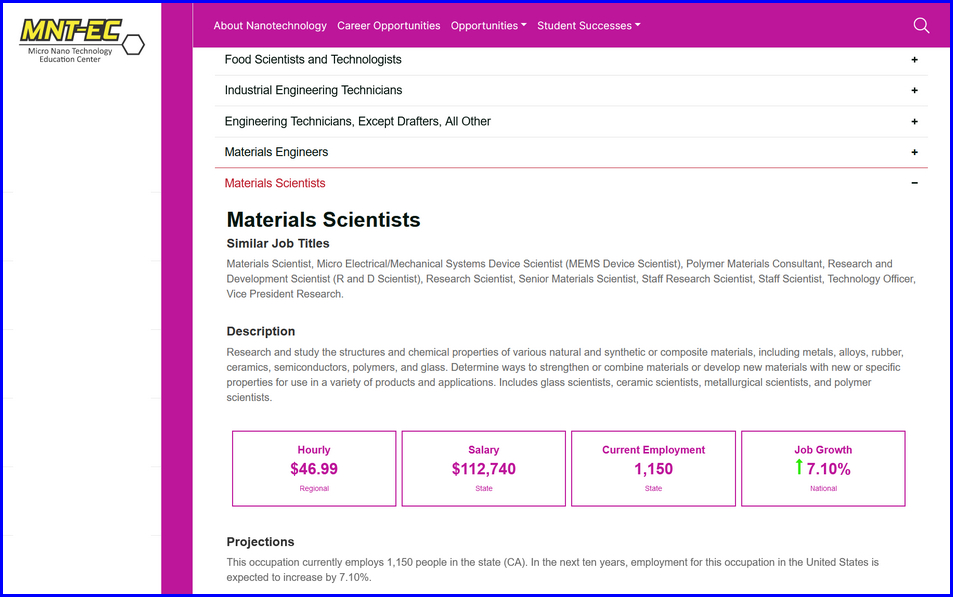
For example, Materials Scientists, is a growth area in the state of California as you can see in this image below. Similar job titles include: Micro Electrical/Mechanical Systems Device Scientist (MEMS Device Scientist), Polymer Materials Consultant, Research and Development Scientist (R and D Scientist), Research Scientist, Senior Materials Scientist, Staff Research Scientist, Staff Scientist.
Dental Laboratory Technicians is another growth occupation that currently employs 1,510 people in the region (Los Angeles-Long Beach-Glendale, CA Metropolitan Division). In the next ten years, employment for this occupation in the United States is expected to increase by 14.40 percent.
Similar job titles include: Crown and Bridge Dental Lab Technician, Dental Ceramist, Dental Laboratory Technician (Dental Lab Technician), Dental Technician (Dental Tech), Denture Technician, Metal Finisher, Model and Dye Person, Orthodontic Laboratory Technician (Orthodontic Lab Technician), Porcelain Technician, Waxer.
To search out specific details around educational requirements and skills needed for nanotechnology jobs, the well-known O*NET OnLine jobs site offers useful summary reports on almost every Nano job (and almost every other job under the sun). Sample of nano job titles: Engineering Technician, Laboratory Technician (Lab Technician), Nanofabrication Specialist, Process Engineering Technician, Research Associate, Research Scientist, Research Specialist, Research Technician, Scientific Research Associate, Technical Research Scientist.
Two helpful and popular videos are found on the MNT-EC Students and Parents page, scroll down and you will find:
Dr. Matt Hull of Virginia Tech presented his talk, X/Nano: The Enabling Potential of a Career in Nanoscience, during the Atlanta Public Schools’ Gifted Synergy Symposium on November 5, 2020.
Dr. Jim Marti of the Minnesota Nano Center, University of Minnesota, presented his talk, Careers in Nanotechnology: Opportunities for STEM Students, to high school and community college educators during an information session on the Research Experiences for Teachers across the NNCI program.
If you are looking to get an on-the-ground level perspective from a working technician, Dr. Peter Kazarinoff’s Talking Technicians Podcast is a must-listen. The podcast interviews micro and nano technicians and their stories of how they chose the field and what they do on a daily basis.
According to CareerExplorer.com, “there are currently an estimated 132,500 nanotechnology engineers in the United States. The nanotechnology engineer job market is expected to grow by 6.4% between 2016 and 2026.” The top states for Nanotechnology Engineer jobs include:
California
17,820
Texas
10,760
Florida
8,020
Michigan
7,350
Ohio
6,870
Maryland
4,790
Virginia
4,640
Louisiana
4,580
Pennsylvania
4,440
Illinois
4,350
New York
4,100
Considering the enormous nanotechnology opportunity at the national level, it is important to point out that MNT-EC is a national center based at Pasadena City College in California, but its partners and affiliates in micro- and nanotechnology span the entire USA. There are many nanotech programs that can prepare you for a job in nanotechnology, here are a few partner details that can help you explore:
Northeast Advanced Technological Education Center (NEATEC)
Housed at SUNY Polytechnic Institute in Utica, NY: the Northeast Advanced Technological Education Center (NEATEC) mission is to attract and train a technician workforce for the semiconductor/advanced manufacturing industries. Read more about Associate Director Kate Williams Alcott’s work to recruit veterans and transitioning military members who are interested in nanotechnology training and jobs. If you are a veteran or active duty military member in transition, check out this upcoming program that still has seats available (at publication) – the flyer has all the info for the January workshop including info on the companies that are interested to hire.
Ivy Tech Community College in Fort Wayne, Indiana
If you search for 2-year nanotechnology job programs, Ivy Tech is often on page one of the results. Cait Cramer is the Assistant Program Chair of Mechanical Engineering Technology at Ivy Tech Community College and a partner here at MNT. Her focus is on microtechnology and enhancing MEMS (Microelectromechanical systems) education. Her full bio and LinkedIn profile is here on the MNT Partner page.
Support Center for Microsystems Education (SCME)
Dr. Matthias Pleil is well known in the Micro Nano world as the Principal Investigator for two NSF funded centers, the Southwest Center for Microsystems Education (2004-2018) and the Support Center for Microsystems Education (2017) housed at the University of New Mexico. Read his full bio here.
The SCME is packed with microsystems education resources including a popular YouTube channel filled with micro and nano videos. To go even deeper in the opportunities in microtechnology and nanotechnology for jobs, internships, and general networking, consider joining the MNT Special Interest Group and be part of the Micro Nano Education community.
Two additional resources that list out nanotechnology job info and salaries are also affiliates or partners here at MNT-EC. One of our National Science Foundation (NSF) Advanced Technological Education (ATE) program partners is the National Nanotechnology Coordinated Infrastructure (NNCI is an NSF-supported initiative). It provides researchers from academia, small and large companies, and government with access to university user facilities with leading-edge fabrication and characterization tools, instrumentation, and expertise within all disciplines of nanoscale science, engineering and technology. NNCI has a terrific overview of careers in nanotechnology.
NNCI cites Recruiter.com data that can give you an idea of what a nano future holds in regards to expected nanotechnology salaries:
Two Year Associate’s – $35,000 – $52,000
Four Year Bachelor’s – $40,000 – $65,000
Six Year Master’s – $60,000 – $80,000
Eight Year Doctorate – $75,000 – $150,000
U.S. salaries for nanotechnology engineering range from $52,000 to $150,000 with the average $95,000 according to Recruiter.com.
The National Nanotechnology Initiative, better known as Nano.gov, has a dedicated page to Associate Degrees, Certificates, & Job Opportunities in Nanotechnology for technician level work (good paying, too) requiring a 2-year degree, including links to many of the top schools that can help you get a certificate or degree on your path to a nano job. If you are after a 4-year or graduate opportunity, then check this page.
As you can see, the growth in nanotechnology jobs is on an upward trend. Keep up with the news and resources by bookmarking this page as we will continue to update it to help you find that dream nanotechnology job.