Abstract
The current era presents an exciting opportunity for higher education. Numerous promising use cases have emerged over the past two years that can specifically enhance instructional methods and lesson plan delivery by using AI. This development coincides with alarming declines in student retention, achievement of learning outcomes, and graduation rates, particularly in the post-COVID context. While AI continues to change rapidly, the conventional pedagogy and instructional methods continue to lag, specifically with respect to AI adoption for student engagement. We propose that through the quick adoption and integration of AI tools and the emphasis on personalization suggested by the VARK learning model, educators can immediately improve student learning outcomes. We demonstrate this by showing a few quick use cases for this technology as well as how it can leverage the VARK model to yield immediate results.
Keywords: personalization, artificial intelligence, VARK model, retention
© 2026 under the terms of the J ATE Open Access Publishing Agreement
Introduction
The reality of education, especially in today’s times, is that students undoubtedly learn in different ways. The VARK (Visual, Auditory, Reading/Writing, and Kinesthetic) learning styles model posits that students have distinct preferences for acquiring and retaining knowledge. This simply means that some students learn by seeing, some by listening, some by reading or writing, and others by doing [1]. Traditional lecture-based teaching methods often fall short for many students due to factors such as cognitive overload [2], multitasking challenges associated with simultaneous listening and note-taking [3-5], the sheer volume of information presented [6], and classroom distractions [7]. Incorporating deep processing activities has been shown to enhance understanding and retention compared to shallow processing [8, 9]. Research suggests that integrating activity-based learning practices like retrieval practice, spaced repetition, and case-based learning into the curriculum can mitigate knowledge decay and improve retention [10]. Furthermore, evidence indicates that students experience higher failure rates in conventional lecture-based environments compared to those employing active learning methods, particularly in STEM disciplines [11]. To prevent students from becoming passive recipients of information, lectures must be more engaging, considering environmental factors, learning styles, and personal preferences. Striving for deep cognitive engagement is essential to avoid such outcomes [12]. By differentiating instruction through blended learning settings and aligning teaching methods with VARK preferences, educators can enhance knowledge retention and foster inclusivity [13]. This briefing underscores the relevance of the VARK model and highlights powerful, evolving generative AI tools available today to facilitate personalized learning.
Methods
Research shows that 13% of students delayed graduation and 40% lost a job, internship, or even a new job opportunity during the COVID-19 pandemic [14]. While the pandemic is one of many factors affecting student success, there is an urgent need to adapt to instructional strategies. Employing the VARK model as a framework for instructional design can significantly benefit diverse student populations across disciplines. Education pedagogy researchers have tested the VARK model and determined that students’ learning preferences lean towards auditory and kinesthetic means, followed by reading/writing and visual aids [15]. This means that greater interactivity is generally desired by students, presenting obvious challenges for instructors as it requires greater work effort to develop and execute such lesson plans. Thankfully, generative AI can now fully serve as a work aid to instructors desiring to create highly interactive and scalable lesson plans for students.
We highlight three AI tools as examples: ChatGPT, Claude, and Boodlebox. Each tool has a strong potential to improve learning personalization across all instructional modalities—including traditional classrooms, online synchronous/asynchronous formats, and hybrid environments. More specifically, we would use each of these tools to illustrate the method by which they can achieve improvement related to student experiences and learning outcomes:
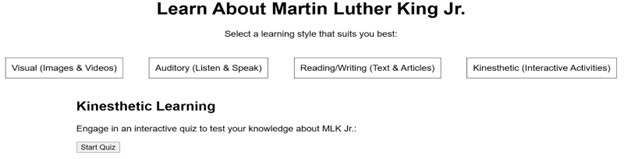
- Topic-specific, interactive learning (e.g., ChatGPT) – This approach uses ChatGPT to create highly interactive, topic-focused learning environments that boost student engagement and understanding, easily incorporating all VARK learning modes.
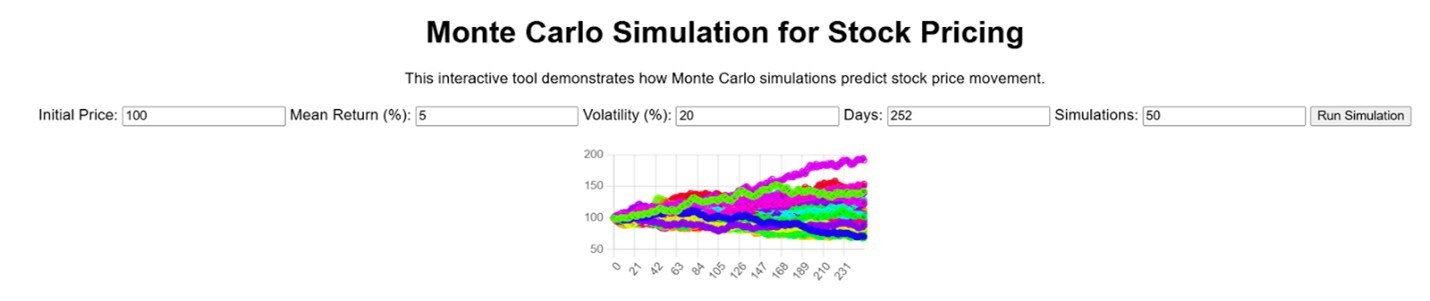
- Role-play & simulation (e.g., CustomGPT’s, Claude) – In this method, tools like Claude are used to build CustomGPTs that support innovative role-playing scenarios (which can also be turned into audible conversations) and visual simulations. These experiences allow students to engage with and experiment with course concepts in dynamic, interactive ways.
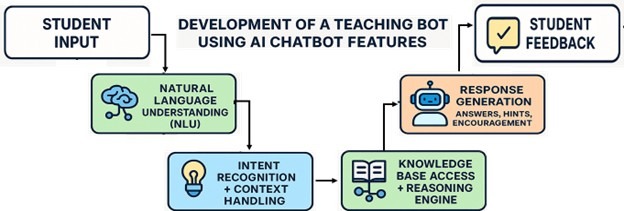
- TeachingBOT personalized tutor (e.g., Boodlebox) – Using Boodlebox, instructors can develop a teaching chatbot by uploading subject-specific content, which is then integrated with large language models (LLMs). The result is a personalized digital tutor that supports student learning outside the classroom by answering questions and reinforcing material—without simply providing the answers. The student experience will be high-touch, personalized, and directed towards their own learning needs within a given lesson plan.
Results
In this section, resulting visualizations depicting a few basic AI tools & techniques will be shown. While these tools and associated techniques continue to advance at a rapid pace, below are four implementation use cases that can be adopted by educators to teach specific topics to facilitate VARK learning styles.

Conclusion
This briefing illustrates that VARK learning styles can be effectively supported through the strategic use of modern generative AI tools and techniques. We remain optimistic that dramatic improvements in student outcomes are attainable, provided educators intentionally align their curriculum with VARK learning principles. The examples above demonstrate how freely available AI tools can be leveraged today to support instructional personalization across subject areas, delivery formats, and assessment strategies. In a 2024 paper, over a one-month period using an AI chatbot in a classroom to reinforce course concepts, 91% of queries were answered with student satisfaction. The study also found that those who used the tools provided scored better on exams [16].
By incorporating the VARK learning model as a foundation for differentiated instruction and combining it with AI-powered platforms for dynamic content generation, educators can deliver engaging, accessible, and effective instruction for all learners. While each tool has unique strengths and application areas, the common thread is their ability to deliver personalized, adaptive learning experiences using large language models (LLMs) and instructional simulations. In conclusion, we aim to shape the future of higher education by bridging the gap between traditional pedagogical models and emerging AI technologies. The impetus for presenting this rapid communication now is to instill some urgency for embracing easily accessible AI technology that can make a meaningful difference in student experiences and learning outcomes.
Acknowledgements. This work was supported by CT State Community College, Northwestern.
Disclosures. The authors declare no conflicts of interest.
[1] N. Fleming, VARK: A Guide to Learning Styles. Christchurch, NZ: Bonwell Green Mountain Press, 2009. [Online]. Available: https://vark-learn.com
[2] P. Chandler and J. Sweller, “Cognitive load theory and the format of instruction,” Cogn. Instr., vol. 8, no. 4, pp. 293–332, 1991. [Online]. Available: https://doi.org/10.1207/s1532690xci0804_2
[3] B. B. Armbruster, “Taking notes from lectures,” in Handbook of Research on Teaching and Learning, S. Graham, Ed., New York, NY: Routledge, 2009, ch. 7, pp. 97–118. [Print only; summary available]: https://www.routledge.com/Handbook-of-Research-on-Teaching-and-Learning/Graham/p/book/9780367659304
[4] K. A. Kiewra, “How classroom teachers can help students learn and teach them how to learn,” Theory Into Practice, vol. 41, no. 2, pp. 71–80, 2002. [Online]. Available: https://doi.org/10.1207/s15430421tip4102_3
[5] A. King, “Schema training for college students,” Contemporary Educational Psychology, vol. 17, no. 2, pp. 150–162, Apr. 1992. [Online]. Available: https://doi.org/10.1016/0361-476X(92)90046-J
[6] D. L. Schwartz, J. D. Bransford, and D. Sears, “Efficiency and innovation in transfer,” in Transfer of Learning from a Modern Multidisciplinary Perspective, J. P. Mestre, Ed. Greenwich, CT: Information Age Publishing, 2005, pp. 1–51. [Online book preview]: https://books.google.com/books/about/Transfer_of_Learning.html?id=pgf6PQAACAAJ
[7] S. M. Ravizza, M. Uitvlugt, and K. M. Fenn, “Logged in and zoned out: How laptop internet use relates to classroom learning,” Psychological Science, vol. 28, no. 2, pp. 171–180, Feb. 2017. [Online]. Available: https://doi.org/10.1177/0956797616677314
[8] M. T. H. Chi and R. Wylie, “The ICAP framework: Linking cognitive engagement to active learning outcomes,” Educational Psychologist, vol. 49, no. 4, pp. 219–243, 2014. [Online]. Available: https://doi.org/10.1080/00461520.2014.965823
[9] P. A. deWinstanley and R. A. Bjork, “Processing strategies and the generation effect: Implications for making a better reader,” Memory & Cognition, vol. 30, no. 6, pp. 1071–1079, 2002. [Online]. Available: https://doi.org/10.3758/BF03194325
[10] G. Csaba et al., “Variability in knowledge retention of medical students: Repeated and recently learned basic science topics,” BMC Med. Educ., vol. 25, no. 1, p. 523, Apr. 2025. [Online]. Available: https://doi.org/10.1186/s12909-025-07096-9
[11] S. Freeman et al., “Active learning increases student performance in science, engineering, and mathematics,” Proc. Natl. Acad. Sci., vol. 111, no. 23, pp. 8410–8415, Jun. 2014. [Online]. Available: https://www.pnas.org/doi/full/10.1073/pnas.1319030111
[12] D. Cerbin, “Improving student learning from lectures,” Teaching and Learning Resources Review, 2018. [Online]. Available: https://takinglearningseriously.com/wp-content/uploads/2019/08/Improving_student_learning_CERBIN.pdf
[13] S. J. Ansari, “Psychological aspects of VARK learning styles in blended learning: A theoretical analysis,” Int. J. Creative Res. Thoughts (IJCRT), vol. 11, no. 10, pp. 352–362, Oct. 2023. [Online]. Available: https://www.academia.edu/108842225
[14] E. M. Aucejo et al., “The impact of COVID-19 on student experiences and expectations: Evidence from a survey,” J. Public Econ., vol. 191, p. 104271, Nov. 2020. [Online]. Available: https://doi.org/10.1016/j.jpubeco.2020.104271
[15] Prithishkumar, IJ; Michael, SA. Understanding your student: Using the VARK model. Journal of Postgraduate Medicine vol. 60(2), p 183-186, Apr–Jun 2014. | DOI: 10.4103/0022-3859.132337. Available: https://pdfs.semanticscholar.org/4aed/8892364a21a9f4b2b1eeb650ec69ac027975.pdf
[16] M. Gunawan, M. Maia, S. Klein, Meyliana, and Surjandy, “ChatGPT and VARK Model in Education: A Systematic Literature Review,” in Proceedings of the 2024 International Conference on Information Management and Technology (ICIMTech), Bali, Indonesia, Aug. 2024, pp. 1–6. doi: 10.1109/ICIMTech63123.2024.10780818