


Abstract
This rapid article introduces and presents the Microelectronics and Nanomanufacturing Certificate Program (MNCP) hosted by the Center for Nanotechnology Education and Utilization (CNEU) at the Pennsylvania State University. The program aims at training veterans, active-duty military members, and their immediate relatives nationwide to enter the microfabrication and nanotechnology workforce. This not only contributes to meeting the growing workforce needs but also provides transition paths for veterans in the areas of semiconductor fabrication and nanomanufacturing. The MNCP is supported by the National Science Foundation and involves significant contributions from community colleges, universities, and industry. This article provides an overview of the functioning of the MNCP that is based on a resource-sharing model.
Keywords: nanotechnology education, microelectronics education, semiconductor processing, veterans, hands-on laboratories, workforce development
© 2026 under the terms of the J ATE Open Access Publishing Agreement
There is a strong need for a nanomanufacturing workforce to meet the demands of microelectronics and semiconductor technologies. A nationwide demand for this workforce and research development is also identified by the CHIPS (Creating Helpful Incentives to Produce Semiconductor Chips) and Science Act [1]. Colleges and universities are essential in training the microelectronics and nanomanufacturing workforce [2], [3]. The military has tens of thousands of enlisted personnel, officers, and command staff who are well-suited to the advanced technology industry. Many have experience on military technology teams, helping build mechanical, electrical, and communication systems. They already have sought-after leadership qualities based on their ability to meet deadlines, manage teams, discipline, safety awareness, and work in extreme conditions [4]. The MNCP integrates microelectronics and nanomanufacturing with these military-related skill sets very precisely. The MNCP does so through industry-community college-university partnerships, adaptive curricula, best-practice sharing, coordination among similar programs, and developing newer approaches to creating educational and workforce training programs.
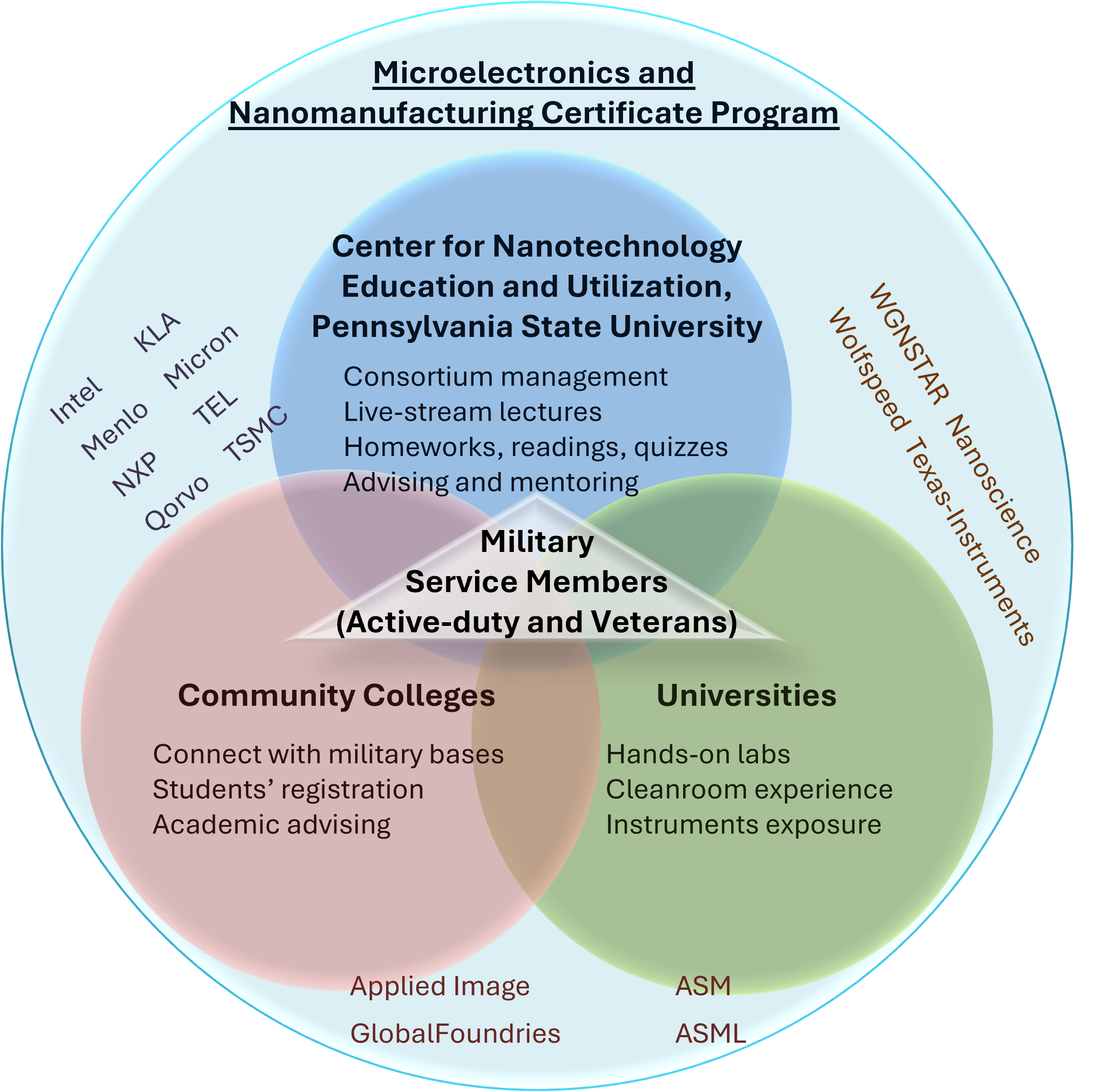
The MNCP consists of CNEU, community colleges (CCs), universities, and industry partners. The role of CNEU is to design and develop a curriculum and syllabus, maintain synchronization among the program’s components, deliver live-stream lectures, and advise or co-mentor students. CNEU oversees national program management, lectures, professional development (e.g., resume development), industry presentations, homework, quizzes or mini-exams, projects, and the administration of certificates. CCs and universities are paired based on their geographic proximity. CCs are responsible for veterans’ recruitment, establishing potential ties with local military bases and groups, and seeking out local employers who may be interested in the skill sets acquired during the MNCP. CCs intending to establish nanotechnology and microelectronics programs have local academic advisors to guide the students throughout the program. Universities involved in the MNCP have cleanrooms where students receive hands-on lab training and experimental skillsets. Pairs of CCs and universities in various states are shown in Table I. CNEU, CCs, and universities work with industry to review curricula, give guest lectures in classes, and provide potential employment opportunities. Partnered industries could serve as an advisory board, provide feedback on curriculum and course design, give company presentations to students as a recruitment mechanism, interview students, or hire students. Figure 1 shows the framework and different components of the MNCP.
Pedagogical methods, typically developed for undergraduate and graduate students, are significantly adapted to train varied student populations, including veterans. Veterans gain intensive training, including significant hands-on lab training in cleanrooms. The labs are optimized to provide sufficient hands-on time to develop skill sets and semiconductor processing experience. Lectures are tailored to focus more on real-life examples and to include more conceptualization than in traditional classes. Lectures are accompanied by reading assignments that directly translate into reading standard operating procedures (SOPs), safety data sheets (SDS), and equipment manuals. In the MNCP, students also work on independent research projects. Projects boost their confidence in learning a new micro-nano topic on their own and in working in the field.
The MNCP curriculum also prepares students to take three ASTM (American Society for Testing and Materials) certification exams: Nanotechnology Health and Safety, Nanotechnology Fabrication and Infrastructure, and Nanotechnology Characterization. These three certificates are based on 6 ASTM standards: ASTM E2996: Health and Safety, ASTM E3001: Characterization, ASTM E3034: Pattern Generation, ASTM E3059: Infrastructure, ASTM E3071: Materials Synthesis and Processing, and ASTM E3089: Materials Properties and Effects of Size.
Table 1. Community colleges and universities pairs partnered with CNEU in the MNCP
| State | Partnering Community College | Partnering University | |
| 1 | Arizona | Rio Salado College | Arizona State University |
| 2 | California | Southwestern College | University of California, San Diego |
| 3 | Georgia | Georgia Piedmont Techn. College | Georgia Institute of Technology |
| 4 | New York | Tompkins Cortland Community College | Cornell University |
| 5 | North Carolina | Central Carolina Community College | North Carolina State University |
| 6 | Ohio | Central Ohio Technical College | Ohio State University |
| 7 | Pennsylvania | Harrisburg Area Community College | Pennsylvania State University |
| 8 | Texas | Tarrant County College | University of Texas at Arlington |
| 9 | Virginia | Tidewater Community College | Norfolk State University |
In summary, the MNCP has been successful in training veterans, active-duty members, and their immediate relatives in nanofabrication and semiconductor processing since it began about three years ago. More than 120 students have completed this program and graduated. The MNCP continues to grow and expand in more states, serving and training our military personnel and their immediate relatives in the growing fields of microelectronics and nanomanufacturing
Acknowledgements. We would like to acknowledge NSF grant 2229983 for funding and supporting this work and the program. We are thankful to our military personnel and their immediate relatives, and our nationwide program partners based in universities, community colleges, and in the semiconductor nanomanufacturing as well as adjacent industries.
Disclosures. The authors declare no conflicts of interest.
[1] H.R.4346-Chips and Science Act, Public Law No 117-167, 2022.
[2] R. Giasolli, D. Tao, S. Neuen, “Nanotechnology outreach at mall of America: Fostering STEAM interest,” J ATE, vol. 3, no 1, pp. 42-46, 2024, doi: https://zenodo.org/record/10945936.
[3] V. Saravade, Z. Gray, R. Lindenberg, Osama Awadelkarim, “Simulation approaches for microelectronics and nanofabrication advanced technology education,” J ATE, vol. 4, no 1, 2025, doi: https://zenodo.org/records/15264589.
[4] A. Ghosh, M. Santana, B. Opelt, “Veterans’ reintegration into higher education: A scoping review and recommendations,” J. Stud. Aff. Res. Prac., vol. 57, no 4, pp. 386-402, 2020, doi: https://doi.org/10.1080/19496591.2019.1662796.