Abstract
Large language models are increasingly used to support instruction, yet evidence in construction management education remains limited. This study evaluates an AI-supported instructional model implemented in an asynchronous construction management course and examines student perceptions and academic performance. The model combined four coordinated resources: (1) AI voice-over lectures, (2) an AI-derived course text, (3) lecture transcripts and study notes, and (4) a custom course chatbot. Resources were designed using Cognitive Load Theory to improve clarity, reduce extraneous load, and provide timely help without continuous live instruction. Students completed a post-course survey, and a subset participated in semi-structured interviews. Survey results showed generally positive perceptions of clarity, engagement, and usefulness for exam preparation; interview themes emphasized convenience, adaptive support, and the need for verification and instructor oversight. To explore learning outcomes, exam scores from the AI-supported online section were compared with those from a traditional in-person section using the same assessments; performance was comparable across the four exams. Overall, results suggest that a purposefully designed AI “content ecosystem” can enhance the asynchronous learning experience without sacrificing measurable course performance.
Keywords: AI instructional design, pedagogy, ChatGPT, LLMs, asynchronous learning, cognitive load
© 2026 under the terms of the J ATE Open Access Publishing Agreement
Introduction
Artificial intelligence (AI) and, more recently, large language models have accelerated innovation in higher education, offering scalable personalization, rapid feedback, and always-available support [1]. In parallel, the post-pandemic shift toward online delivery has made asynchronous learning central to many programs. Well-designed asynchronous formats can achieve learning gains comparable to those of synchronous instruction; however, students often report a higher cognitive load and a greater need for timely guidance [2]. Within construction management (CM), these trends intersect with a curriculum that is procedural (sequencing/scheduling), visual and spatial (BIM/4D visualization), and data-intensive (model-based information), which heightens the need for clear explanations, modular content, and on-demand help [3]. Against this backdrop, AI-generated instructional materials and course chatbots offer consistent presentation and immediate clarification when instructor presence is limited [4], [5].
This study examines the role of AI in enhancing asynchronous learning for CM students, focusing on how learners experience the clarity, usefulness, and learning value of AI-generated materials and a lightweight course chatbot within an undergraduate CM course. In developing the curriculum, the work is guided by Cognitive Load Theory (CLT), which differentiates between intrinsic, extraneous, and germane load and recommends design moves such as segmentation, signaling, and coordinated narration with graphics to reduce unnecessary processing and promote deeper learning [6]. In this context, AI is treated not as a novelty but as a vehicle for CLT-consistent design, delivering concise, modular presentations and just-in-time explanations intended to make complex CM topics easier to follow without displacing productive effort. This study investigated students’ perceptions and performance outcomes in an AI-enhanced asynchronous construction management course. The following research questions guided the work: R1: How do students perceive the usefulness and learning impact of the AI-generated instructional materials used in this course? R2: To what extent do students perceive these AI-generated materials as clear and easy to follow compared with traditional resources (instructor-led lectures and the course textbook)? R3: In comparable course modules, how do students’ reported engagement and learning experiences differ when using AI-generated materials versus traditional resources? R4: Do students demonstrate differences in exam performance between the AI-enhanced asynchronous course section and a traditional live in-person section of the same course?
Literature Review
AI in Higher Education
AI has rapidly transformed higher education by introducing personalization, efficiency, and scalability into learning environments. Contemporary AI-driven systems such as adaptive learning platforms, intelligent tutors, and chatbots can individualize instruction, automate feedback, and enhance engagement [1], [7]. Studies show that these tools adapt content difficulty and scaffolding, improving outcomes in STEM and language learning while allowing students to focus on higher-order tasks [8]. AI chatbots bridge instructor gaps in asynchronous courses by offering real-time explanations and around-the-clock assistance, fostering a sustained sense of presence and support [4]. However, scholars caution that excessive reliance on AI may encourage cognitive offloading, which limits critical thinking and problem-solving [9]. This tension positions AI as both a facilitator of learning and a potential barrier to deeper cognitive processing [10]. Overall, the literature highlights AI’s potential to enhance instructional clarity, personalize learning, and scale academic support when implemented thoughtfully, laying the groundwork for examining its role within construction management education.
Asynchronous Learning in Construction Management Education
Asynchronous online learning has become increasingly prevalent in CM programs since the COVID-19 pandemic shifted instruction to remote learning. This format offers flexibility for CM students, who often balance coursework with internships or job site visits. However, the literature reports persistent challenges in translating CM’s traditionally hands-on, collaborative pedagogy into asynchronous environments. Key issues include reduced student engagement and limited real-time collaboration with instructors and peers, both of which are essential in CM learning [11].
Social interaction in online classes is often perceived as inferior to face-to-face settings, which can contribute to isolation and lower participation rates [11]. Motivation can also wane without the structure of synchronous sessions, thereby negatively impacting learning outcomes [12]. A systematic review by Jayathilaka et al. (2025) highlights the importance of implementing deliberate strategies that integrate digital pedagogy with student-centered and problem-based approaches [13]. Clear, well-structured content and frequent feedback are especially important for keeping CM students on track [3]. Asynchronous, engaging, and interactive materials are needed to sustain learner interest [14]. Ensuring that students can visualize construction processes and actively apply concepts remains challenging because text or video alone may not convey complex spatial or project management ideas [14].
AI-Enhanced Asynchronous Learning
AI applications tailored for asynchronous learning aim to mitigate the drawbacks of self-paced courses by improving clarity, reducing extraneous cognitive load, and providing timely support [4]. AI-generated materials, such as video lectures, slides, and practice items, can simplify technical texts and provide leveled examples aligned with prior knowledge, helping minimize confusion [15]. In construction management, this can translate into accessible summaries and visualizations of complex theories or codes, while offloading routine content creation so instructors can focus on mentorship [16]. AI-generated formative feedback delivers immediate, tailored hints and can even reduce perceived cognitive load, thereby improving students’ learning efficiency and the platform’s usefulness [16]. Students often report positive perceptions of AI-assisted modules, citing clearer explanations and round-the-clock help that strengthen productivity and confidence [17].
A particularly active line of work examines AI chatbots as virtual tutors that clarify concepts, generate resources, and support reflection, thereby promoting self-regulated learning [17]. In practice, GPT-class chatbots can answer CM scheduling questions, surface relevant past-project cases, and walk students through calculations step by step [17]. Empirical evidence suggests that chatbots can facilitate critical thinking and collaborative knowledge construction, particularly when instructors provide structured guidance and prompts [4]. Benefits include greater engagement, individualized feedback, and a more interactive asynchronous experience [8]. Key cautions remain regarding over-reliance, accuracy, and bias, which require accuracy checks, transparency, and instructor oversight, particularly for CM content [9].
Methods
This study employed a convergent parallel mixed-methods design in which quantitative survey findings and qualitative interview insights were collected concurrently and integrated during interpretation. The quantitative strand was dominant (student survey ratings), while qualitative data provided explanatory depth and triangulation for students’ perceptions.
Course Context and Participation
The study was conducted in a third-year undergraduate construction management course delivered in two formats: (1) an asynchronous online section supported by AI-enabled content and (2) a traditional live in-person section used for performance benchmarking. The online section included 15 students, and the in-person section included 28 students. Students were not assigned a course format by the research team. Instead, they enrolled through the university’s normal course registration process in either the asynchronous online or live in-person section. Thus, participation in each learning format reflected authentic course-enrollment conditions, including students’ selection of an available modality that aligned with their scheduling needs and learning preferences. The study, therefore, compares naturally occurring course sections while holding course modules, assessments, grading criteria, and assessment timing constant.
The survey and interviews were administered to students in the online AI-enhanced section; the in-person section was used to compare exam performance distributions on a common course assessment. Recruitment was conducted through an announcement in the learning management system that described the study’s purpose, procedures, and voluntary nature of participation. All online students completed the survey. The two sections covered the same course modules, learning objectives, exam content, grading criteria, and assessment schedule. The traditional in-person section was delivered through live instructor-led class meetings using the instructor’s existing lecture materials, assigned course resources, and standard student support mechanisms such as class discussion, email, and office hours. No AI-generated material was integrated into the traditional in-person section. Although office hours and email provided conventional forms of instructor support, they were not treated as direct equivalents to the chatbot because they differ in availability, immediacy, and interaction format. Therefore, the comparison should be interpreted as a course-level comparison between an AI-enhanced asynchronous section and a traditional in-person section, rather than a tool-by-tool experimental equivalence between individual resources.
AI-Enhanced Instructional Content Ecosystem
The online course section integrated four coordinated AI-supported materials: (1) AI-generated voice-over lectures, (2) an AI-derived textbook built from lecture content with supplemental visuals, (3) AI transcripts and structured notes embedded in slide decks, and (4) a custom GPT chatbot trained on course materials. Content was designed using CLT principles to support clarity, reduce extraneous load, and provide “just-in-time” support in an asynchronous setting.
Existing PowerPoint lectures from prior semesters served as the source content. For each module, the researcher/instructor followed this pipeline: (1) generate a transcript from the original lecture audio; (2) refine the transcript into an instructor-like narration script using ChatGPT; (3) synthesize the narration using ElevenLabs with an instructor-authorized voice model and embed the audio into the slide deck to produce a video-style lecture; (4) integrate the narration, transcript, and structured notes into the lecture presentation using Storyline; (5) generate a corresponding module chapter (AI-derived textbook) using the finalized script and slide content using ChatGPT; and (6) assemble the slide deck, narration script, and textbook chapter as the knowledge base for a custom GPT configured with structured instructions to support question answering, concept review, and content navigation aligned to the module.
Course modules, exam content, grading criteria, and assessment timing were held constant across the asynchronous online and live in-person sections. The primary difference between sections was delivery mode, with the online section supported by the AI-enabled instructional ecosystem.
Data Collection Instruments
The survey collected student perceptions of the four AI-supported materials. Closed-ended survey items measured perceived clarity, usefulness, organization, engagement, and learning support using a consistent 5-point Likert-type agreement scale, ranging from 1 = Strongly Disagree to 5 = Strongly Agree. This scale was selected because it provides a familiar, low-burden format for capturing students’ level of agreement with perception-based statements while allowing responses to be summarized clearly using descriptive statistics. Higher mean scores indicate stronger agreement with the item statement. Items were phrased as direct statements about each AI-supported resource, such as “The material was clear,” “Useful for my learning,” and “Helped me stay engaged.” Comparative items used the same scale and asked students to rate the AI resource relative to the corresponding traditional resource. The survey also included three open-ended questions: “What is your overall opinion of the AI-generated materials used in this class?” “Is there any AI-generated material that was especially valuable that you wish were used in more CSM courses?” and “Is there any AI-generated material used in this course that you do not use or do not like?”
At the end of the survey, students were invited to participate in a follow-up semi-structured interview. Interviews examined (a) how students used each AI resource, (b) perceived benefits and limitations, and (c) relationships between AI tool use and study behaviors. Three students participated in follow-up interviews. These interviews were used to provide explanatory depth, illuminate how students interacted with AI-enabled resources, and contextualize patterns observed in the survey and assessment outcomes. The interview findings are therefore presented as illustrative themes.
Data Analysis
Closed-ended survey responses were analyzed using item-level means and standard deviations to preserve the interpretability of students’ perceptions across the AI-supported resources. Internal consistency was assessed for multi-item survey groupings using Cronbach’s alpha; coefficients ranged from .72 to .97, indicating acceptable to excellent internal consistency. Performance comparisons were interpreted using descriptive statistics, confidence intervals, effect sizes, and Welch’s two-sample t-test, which is appropriate for unequal group sizes and variances. Welch’s two-sample t-test is a variation of the independent-samples t-test that does not assume equal variances between groups. This approach was selected because the online and in-person sections differed in sample size (n = 15 and n = 28, respectively) and may exhibit unequal score variability, making Welch’s test more appropriate than the traditional t-test. Open-ended survey responses were analyzed using inductive thematic coding. Responses were read line by line; initial codes were assigned to recurring ideas, and related codes were grouped into broader themes. Because some responses addressed more than one idea, individual responses could be assigned to multiple themes. Credibility was supported through a research team review of the codebook and theme assignments, the use of representative verbatim quotations, and triangulation with interview findings and quantitative survey results.
Results and Discussion
Students’ Perception of the Four AI Course Materials
Student perceptions were collected for four instructional AI tools integrated into the course. Each component was rated for clarity, usefulness, engagement, and perceived contribution to learning. Descriptive statistics for each item are reported in Table 1.
Table 1. Descriptive Statistics of AI-Generated material
| AI-Generated Textbook | Mean | SD | AI voice-over lecture | Mean | SD |
|---|---|---|---|---|---|
| Useful for my learning | 4.00 | 0.53 | Useful for my learning | 4.06 | 0.7 |
| The material was clear | 4.00 | 0.53 | The material was clear | 4.00 | 0.65 |
| Helped me stay engaged | 3.90 | 0.59 | Helped me stay engaged | 3.93 | 0.79 |
| AI-Transcript Note | Mean | SD | AI-Custom Chatbot | Mean | SD |
|---|---|---|---|---|---|
| Useful for my learning | 3.66 | 0.61 | Useful for my learning | 4.13 | 0.83 |
| The material was clear | 3.66 | 0.61 | The material was clear | 4.13 | 0.74 |
| Helped me stay engaged | 3.60 | 0.63 | Helped me stay engaged | 4.13 | 0.74 |
| I would trust this component | 4.13 | 0.74 |
Note. Values are mean ratings on a 1–5 Likert-type agreement scale, where 1 = Strongly Disagree and 5 = Strongly Agree. SD = standard deviation.
Students rated all four AI-supported tools positively, with mean scores above the neutral midpoint of 3.0. The custom chatbot received the highest ratings across usefulness, clarity, and engagement (M = 4.13), suggesting that students viewed it as a valuable source of on-demand support. The AI-generated textbook and AI voice-over lectures also received favorable ratings, with mean values near or above 4.0, indicating that students generally agreed that these materials were useful and clear. Transcript notes received slightly lower ratings (M = 3.60–3.66), suggesting that while students found them helpful, they may have relied more heavily on the textbook, lectures, or chatbot. The relatively small SD values indicate generally consistent perceptions across students.
Students’ Perception of the Four AI Course Materials
Table 2 suggests that students perceived the AI-generated materials as well-organized and easy to navigate. The highest-rated item was “Headings and summaries helped me follow the content” (M = 4.20), indicating that students valued the structured presentation of information. Similarly, students rated the language as easy to understand (M = 4.13), supporting the goal of improving clarity in an asynchronous environment. Lower ratings for explanations and examples (M = 3.60) suggest opportunities for additional examples or elaboration on more challenging topics.
Table 2. Students’ Perception of AI-generated material
| Mean | SD | |
|---|---|---|
| The language was easy to understand | 4.13 | 0.51 |
| The structure made it easy to find information | 3.80 | 0.86 |
| The pacing supported my understanding | 3.93 | 0.45 |
| Explanations and examples clarified difficult topics | 3.60 | 0.73 |
| Headings and summaries helped me follow the content | 4.20 | 0.56 |
| Content flowed logically with minimal gaps | 3.73 | 0.79 |
| I did not feel overloaded using the materials | 3.80 | 0.56 |
| I could quickly find answers when reviewing quizzes or exams | 3.86 | 0.74 |
Level of Engagement for AI-generated Textbook and Traditional Textbook
When students were asked to compare the level of AI-generated textbook used in this course with the traditional textbook from the prerequisite course, the mean rating was 3.86, and the SD was 0.91. This suggests a generally positive preference for the AI-generated textbook, while also indicating some variability in individual student views.
Comparing Students’ Perception: AI Voice-Over Vs Human-Recorded Lecture
Student perceptions of the AI voice-over lectures were more mixed. Ratings for persistence (M = 3.40) and sustained focus (M = 3.26) suggest that the AI narration helped students continue through course content. However, lower ratings for cognitive engagement (M = 2.93) indicate that students did not always perceive the AI voice-over as encouraging deeper learning behaviors such as note-taking, reflection, or active processing. The larger SD values suggest greater variation in student preferences regarding AI narration.
Table 3: AI Voice-Over vs. Human-Recorded Lecture
| Mean | SD | |
|---|---|---|
| Interest/enthusiasm (felt curious, not boring) | 3.06 | 1.00 |
| Sustained focus (stayed on task, fewer distractions) | 3.26 | 0.70 |
| Persistence (kept going when content was hard) | 3.40 | 0.50 |
| Cognitive engagement (note-taking, pausing, reflecting) | 2.93 | 0.79 |
| Overall learning experience (positive/helpful) | 3.13 | 0.74 |
Similarly, when students were asked to rate their overall preference of AI-generated voice-over lectures with similar lectures narrated by an instructor, the mean rating was 3.0, and the SD was 0.91. This indicates a neutral overall preference, suggesting that students were divided, with some favoring AI narration and others preferring a human voice.
Comparing Students’ Perception: AI Textbook Vs Traditional Textbook
Compared with a traditional textbook, students generally viewed the AI-generated textbook favorably. The highest rating was for overall learning experience (M = 3.80), suggesting that students perceived the AI-generated text as a useful learning resource. Ratings for interest, focus, persistence, and cognitive engagement all exceeded the neutral midpoint, indicating that students generally preferred or responded positively to the AI-generated text. The moderate SD values indicate some differences in preference but no evidence of strong disagreement among students.
Table 4: AI Textbook vs. Traditional Textbook
| Mean | SD | |
|---|---|---|
| Interest/enthusiasm (felt curious, not boring) | 3.66 | 0.61 |
| Sustained focus (stayed on task, fewer distractions) | 3.73 | 0.70 |
| Persistence (kept going when content was hard) | 3.53 | 0.63 |
| Cognitive engagement (note-taking, pausing, reflecting) | 3.53 | 0.74 |
| Overall learning experience (positive/helpful) | 3.80 | 0.77 |
When students were asked to rate their overall preference for the AI-generated textbook used in this course compared to the traditional textbook from the prerequisite course, the mean rating was 3.86, and the SD was 0.91. This suggests a generally positive preference for the AI-generated textbook, while also indicating some variability in individual student views.
AI-Enhanced Asynchronous Course vs. Traditional Asynchronous Course
When asked to reflect on their overall learning experience in the AI-integrated course compared to a traditional online course without AI-generated content, students reported a favorable impression, with a mean rating of 3.73 (SD = 0.59). This suggests that, on average, students perceived the AI-enhanced learning experience as slightly more effective or engaging than conventional online formats.
AI-Enhanced Asynchronous Students’ Performance vs. Traditional Students’ Performance
Table 5 summarizes performance across four common exams in the AI-enhanced asynchronous online section and the live in-person section. Mean scores were closely aligned across assessments (online: 83.0-88.1%; in-person: 82.0-86.0%). 95% confidence intervals (CIs) are reported to convey the precision of each section’s mean. An interval such as [77.8, 88.2] should be interpreted as a plausible range for the section’s true average score. Because the two sections differed by both delivery mode and AI integration, the performance comparison was interpreted as exploratory and course-level rather than as causal evidence for any single AI tool.
Table 5: Comparison of Students’ Performance
| Assessment | Section | Mean (%) | SD | High | Low | Avg time | 95% CI |
| Exam 1 | Online (AI-enhanced) | 83.0 | 9.41 | 94 | 57 | 41:24 | [77.8, 88.2] |
| Exam 1 | In-person | 82.0 | 13.12 | 100 | 53 | 42:31 | [76.9, 87.1] |
| Exam 2 | Online (AI-enhanced) | 88.1 | 14.91 | 100 | 51 | 53:30 | [79.8, 96.4] |
| Exam 2 | In-person | 84.6 | 9.18 | 98 | 65 | 49:54 | [81.0, 88.2] |
| Exam 3 | Online (AI-enhanced) | 85.0 | 6.32 | 96 | 72 | 31:51 | [81.5, 88.5] |
| Exam 3 | In-person | 86.0 | 14.34 | 100 | 37 | 39:35 | [80.4, 91.6] |
| Exam 4 | Online (AI-enhanced) | 88.0 | 9.36 | 100 | 67 | 27:01 | [82.8, 93.2] |
| Exam 4 | In-person | 86.0 | 9.27 | 100 | 67 | 31:20 | [82.4, 89.6] |
Figure 1 shows the boxplots of student exam performance in the traditional in-person (I) and AI-enhanced online (O) sections across four assessments (E1–E4). Boxes represent the interquartile range (IQR), center lines indicate the median score, whiskers extend to the most extreme non-outlier values, and circles denote outlier observations.
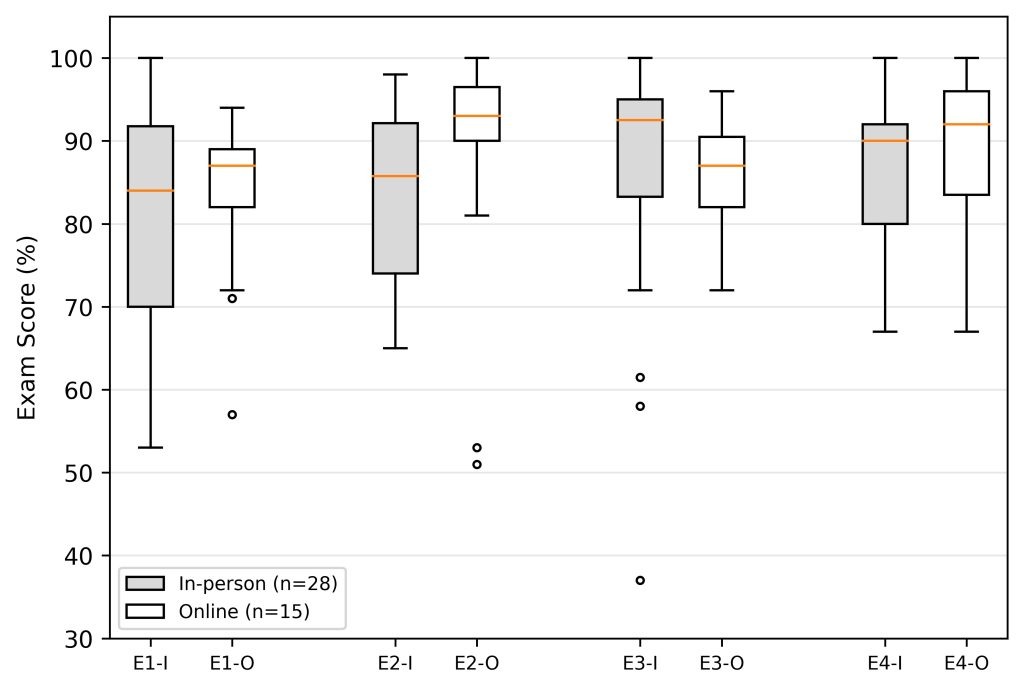
Complementing the interval estimates, inferential comparisons were conducted using Welch’s two-sample t-test. These analyses are presented as exploratory because section membership reflected standard course enrollment rather than random assignment. Consistent with the confidence-interval evidence, Welch’s tests indicated no statistically significant differences in mean exam scores between sections across the four assessments (all p > 0.40). The estimated mean differences (online − in-person) were modest, ranging from −1.0 to +3.5 percentage points, and the corresponding 95% confidence intervals encompassed zero for each examination (Exam 1: [−6.0, 8.0]; Exam 2: [−5.3, 12.3]; Exam 3: [−7.4, 5.4]; Exam 4: [−4.1, 8.1]). Together, the descriptive statistics, confidence intervals, and exploratory inferential analyses indicate that student performance remained comparable across sections throughout the semester. Although small differences in mean scores were observed across individual exams, these differences were inconsistent in direction and magnitude, suggesting that the AI-enhanced asynchronous format supported achievement levels similar to those observed in the traditional in-person section when course content, assessments, grading procedures, and assessment timing were held constant.
Qualitative Findings
This section synthesizes qualitative evidence from the open-ended survey question and follow-up student interviews. Table 6 presents the themes derived from the open-ended survey responses, which provide initial insight into how students perceived and used the AI-enabled course resources.
Table 6. Themes of open-ended survey responses (N=15)
| Theme | n (%) responses mentioning themes | What students described | Representative quote (verbatim) |
|---|---|---|---|
| Theme 1: Written AI materials supported comprehension and convenience | 4 (26.7%) | Students described the AI-generated Word document textbook and notes as easier to read and understand; some preferred reading over listening. | “I really like the AI generated textbook in the word docs. It’s much easier to read through and comprehend.” |
| “It’s good, but it’s new to me, and it is sometimes just easier to read the textbook than listen to AI.” | |||
| Theme 2: Perceived learning value was generally positive, but varied by tool | 13 (86.7%) | Many responses were broadly positive (“helpful,” “engaging”), while others reflected selective adoption depending on the tool. | “great and engaging for the class” |
| “I think they are very helpful for learning” | |||
| Theme 3: Students expressed different levels of use and value for the chatbot | 2 (13.3%) | Some students reported not using the chatbot, while others specifically valued it for asking questions and studying. | “I like it a lot I like the Notes portion of AI but the the whole chatbot thing I do not use.” |
| “I think it is very useful for some things, like the chatbot is great for asking questions and helping study…” | |||
| Theme 4: AI was viewed as a supplement | 5 (33.3%) | A subset emphasized that instructor involvement is still essential | “It is very helpful but does not replace the involvement or effort from the professor.” |
Open-ended survey responses indicated broadly positive perceptions of the AI-enabled resources, with many students describing the materials as helpful and engaging. Students most frequently highlighted the AI-generated written supports (textbook/notes) as easier to read and useful for comprehension and exam preparation, while adoption of the chatbot was mixed, with some students reporting limited use and others valuing it for asking questions and studying. The follow-up interviews reinforced these patterns by clarifying how students used the tools. Participants described the AI textbook and notes as reducing study “friction” through concise explanations and accessible formats. One student explained that the AI-generated textbook became the primary study resource for exam preparation, stating, “When I read through those textbooks, that’s how I prepared for the exam… I ended up getting an 89 on the exam.” Another student emphasized the convenience of the format, noting that “It summarizes everything… there’s all the information I need for that chapter.” The chatbot was viewed as most beneficial for practice and clarification, although levels of use varied across students.
While some benefits of AI-supported learning may extend across disciplines, the findings are particularly relevant to construction management education. Students emphasized the value of concise explanations, visual examples, and easily accessible resources when learning technical topics such as electrical systems and construction-related concepts. At the same time, interview participants highlighted the continued importance of instructor experience and industry perspectives, suggesting that AI functions best as a supplement rather than a replacement for faculty expertise in construction management courses.
Conclusion
Students generally perceived the AI-generated materials as useful for learning, with the AI textbook and notes most frequently cited as supporting comprehension and exam preparation. Students reported that these AI-generated written materials were clear and easy to follow, and many perceived them as comparable to, or even easier to use than, traditional resources, while preferences for AI voice-over versus traditional lecture formats varied. For qualitative feedback and interviews, the AI ecosystem was found to support engagement primarily by reducing friction in studying and enabling on-demand clarification and practice; however, adoption of the course chatbot was uneven, indicating differences in how students integrated conversational AI into their learning experience. Finally, exam performance across four assessments was similar between the online (AI-enhanced) and in-person sections, suggesting no meaningful difference in average grades attributable to delivery mode in this course context. Together, these findings indicate that AI-generated instructional materials can enhance the accessibility and efficiency of asynchronous instruction while maintaining comparable academic outcomes, provided the instructor remains actively involved in structuring content, aligning assessments, and guiding effective tool use.
Limitations
This study has constraints that shape interpretation. The online AI-enhanced section was modest in size, and findings reflect one course context. Accordingly, results are best viewed as early, course-specific evidence rather than broadly generalizable claims about AI in construction education.
Future studies should replicate the approach across additional sections and semesters, track multiple assessments over time, and incorporate measures of learning processes such as cognitive load, study behaviors. Research should also evaluate whether AI-supported resources improve retention and transfer to authentic construction tasks, and test varying levels of instructor guidance to determine how scaffolding influences the quality of student AI interaction. Overall, these results provide promising evidence that a deliberately designed AI-supported environment can improve perceived clarity and study efficiency in an asynchronous CM course while maintaining comparable exam performance to a traditional in-person section.
Acknowledgements. The authors thank the students enrolled in the asynchronous Construction Management course who completed the survey and/or participated in interviews. The authors also acknowledge administrative support from the Department of Construction Science and Management at Clemson University, which facilitated course delivery.
Disclosures. The authors declare no conflicts of interest.
The use of AI. AI-assisted writing tools were used for language editing. The author verified all content, accuracy, completeness, and potential biases.
[1] S. Wang, F. Wang, Z. Zhu, J. Wang, T. Tran, & Z. Du (2024). Artificial intelligence in education: A systematic literature review. Expert Systems with Applications, 252, 124167. https://doi.org/10.1016/j.eswa.2024.124167
[2] C. Hung, S. Wu, Y. Chen, H. Soong, C. Chiang, W. Wang (2024). The evaluation of synchronous and asynchronous online learning: Student experience, learning outcomes, and cognitive load. BMC Medical Education, 24, 5311. https://doi.org/10.1186/s12909-024-05311-7
[3] N. Abouelkhier, M. Shafiq, A. Rauf, & N. Alsheikh (2024). Enhancing construction management education through 4D BIM and VR: Insights and recommendations. Buildings, 14(10), 3116. https://doi.org/10.3390/buildings14103116 S. Mukherjee, The Song of the Cell: An Exploration of Medicine and the New Human. New York: Scribner, 2022.
[4] C. Lo, & K. Hew (2023). A review of integrating AI-based chatbots into flipped learning: New possibilities and challenges. Frontiers in Education, 8, 1175715. https://doi.org/10.3389/feduc.2023.1175715
[5] A. Kallamadugu, N. Lawal, & J. Burgett (2024). A workflow for creating narration for voice-over presentation using commercially available artificial intelligence. Journal of Advanced Technological Education, 3(2), 152–157. https://doi.org/10.5281/zenodo.12826249
[6] F. Paas, & J. van Merriënboer (2020). Cognitive-load theory: Methods to manage working memory load in the learning of complex tasks. Current Directions in Psychological Science, 29(4), 394–398. https://doi.org/10.1177/0963721420922183
[7] E. du Plooy, & D. Casteleijn (2024). Personalized adaptive learning in higher education: A scoping review of key characteristics and impact on academic performance and engagement. Heliyon, 10, e39630. https://doi.org/10.1016/j.heliyon.2024.e39630
[8] J. Du, & B. Daniel (2024). Transforming language education: A systematic review of AI-powered chatbots for EFL speaking. Computers & Education: Artificial Intelligence, 6, 100230. https://doi.org/10.1016/j.caeai.2024.100230
[9] C. Zhai, S. Wibowo, & L. Li (2024). The effects of over-reliance on AI dialogue systems on students’ cognitive abilities: A systematic review. Smart Learning Environments, 11, 28. https://doi.org/10.1186/s40561-024-00316-7
[10] H. Lin, W. Wei, & H. Lu (2025). Facilitator or barrier? A systematic review on the relationship between artificial intelligence technologies and the development of critical thinking skills. Journal of Educational Technology and Innovation, 7(2), 11-24. https://doi.org/10.61414/f2ah8r08
[11] B. Abbasnejad, S. Soltani, & P. Wong (2023). A systematic review of online learning and teaching strategies during the COVID-19 pandemic: Implications for the construction management sector. Smart and Sustainable Built Environment, 13(1).https://doi.org/10.1108/SASBE-08-2022-0174
[12] S. Fabriz, J. Mendzheritskaya, & S. Stehle (2021). Impact of synchronous and asynchronous settings of online teaching and learning in higher education on students’ learning experience during COVID-19. Frontiers in Psychology, 12, 733554. https://doi.org/10.3389/fpsyg.2021.733554
[13] R. Jayathilaka. W. Wijewickrama, M. K., & D. Edwards. (2025). Developing a holistic teaching and learning framework for construction management education: A systematic literature review. Engineering, Construction and Architectural Management. https://doi.org/10.1108/ECAM-11-2024-1557
[14] C. Akpen, S. Asaolu, S. Atobatele, H. Okagbue, & S. Sampson (2024). Impact of online learning on students’ performance and engagement: A systematic review. Discover Education, 3, Article 205. https://doi.org/10.1007/s44217-024-00253-0
[15] E. Kasneci, K. Sessler, S. Küchemann, M. Bannert, D. Dementieva, F. Fischer, …, T. Seidel (2023). ChatGPT for good? On opportunities and challenges of large language models for education. Learning and Individual Differences, 103, 102274. https://doi.org/10.1016/j.lindif.2023.102274
[16] B. Shen, L. Yang , Z. Yan, C. Looi, & D. Gašević (2025). Unraveling the mechanisms and
effectiveness of AI-assisted feedback in education: A systematic literature review. Computers and Education Open, 9, 100284. https://doi.org/10.1016/j.caeo.2025.100284
[17] I. Engeness, &, T. Fossland (2025). Investigating AI chatbots’ role in online learning and digital agency development. Education Sciences, 15(6), 674. https://doi.org/10.3390/educsci15060674