Abstract
This paper presents the development and early outcomes of the Student Produced Autonomous Robotic Creations (SPARC) project at Quinsigamond Community College (QCC), funded by an NSF Advanced Technological Education (ATE) grant (#1954577). Responding to the shortage of skilled automation and robotics technicians in Massachusetts, the project created the 29-credit Automation, Robotics & Manufacturing Technology (ARMTech) certificate program and two optional Robotics Operating System (ROS) courses. Guided by a Business and Industry Leadership Team (BILT) and DACUM analysis, the curriculum was aligned with employer-identified competencies and supported by upgraded laboratories featuring FANUC robots, Amatrol systems, and Automation Studio™. Faculty development emphasized project-based learning, while targeted outreach addressed the underrepresentation of women in STEM through partnerships with the National Institute for Women in Trades, Technology & Science (IWITTS) and women-focused recruitment events. Early results include growing enrollment, direct industry partnerships with Amazon Robotics and regional employers, and pathways that connect certificate completers both to employment opportunities and to stackable credentials leading to associate and bachelor’s degree programs. This case study contributes practical insights for developing industry-aligned, competency-based technician programs and broadening participation in advanced manufacturing and robotics education.
Keywords: automation, robotics, manufacturing technology, community college, NSF ATE, workforce development, STEM education, women in STEM
© 2026 under the terms of the J ATE Open Access Publishing Agreement
Introduction
The rapid evolution of manufacturing technologies has created a pressing demand for a skilled technical workforce, particularly in automation and robotics. In Massachusetts, a shortage of qualified technicians has been identified as a barrier to growth in advanced manufacturing sectors [1]. To address this need, Quinsigamond Community College (QCC) launched the Student Produced Autonomous Robotic Creations (SPARC) project under a National Science Foundation (NSF) Advanced Technological Education (ATE) grant (#1954577). The project, which concluded its fifth year in April 2025, was designed to establish a robust pathway for automation and robotics technicians by creating the Automation, Robotics & Manufacturing Technology (ARMTech) certificate program.
The importance of this initiative is underscored by national workforce trends. Middle-skill STEM roles—positions that do not require a bachelor’s degree—represent more than half of the U.S. STEM workforce [2], and community colleges are the primary providers of career-focused credentials, with over 56% of awards designed to prepare students directly for employment [3]. Within this context, QCC positioned ARMTech as a sustainable, stackable pathway that strengthens workforce readiness while supporting academic transfer options. Prior NSF ATE efforts have demonstrated that industry-driven, competency-based certificate programs can effectively prepare students for these technician-level careers [4].
At the same time, broadening participation remains a critical challenge. Women continue to be underrepresented in STEM, making up only 26% of the U.S. STEM workforce [5] and 28.2% globally [6]. This disparity highlights the importance of intentional outreach strategies to attract and retain women in technical programs.
Building on these insights, the SPARC project developed a case study in program design that integrated industry guidance, project-based pedagogy, upgraded instructional technologies, and targeted recruitment strategies. The following section describes the project’s design and methodology, situating ARMTech within the broader landscape of technician education and workforce development.
Methods
Three primary goals guided the SPARC project:
- Developing a robotics technician certificate program.
- Providing professional development for QCC faculty.
- Launching an outreach program.
The design was drawn from established models within the NSF ATE community, particularly efforts to create stackable, industry-aligned technician certificates in automation and robotics. Similar initiatives have demonstrated the value of employer-validated curricula and project-based approaches in preparing automation technicians for emerging workforce needs [4]. The project’s occupational analysis was conducted using the DACUM process, a well-established method for curriculum development [7], and industry-identified competencies were structured following the Knowledge, Skills, and Abilities (KSA) framework, a widely used standard for workforce development [8].
Curriculum development (Goal 1) at QCC was structured through the use of a Business and Industry Leadership Team (BILT) and the DACUM process, ensuring alignment with local industry expectations. By centering the ARMTech certificate on competencies such as PLC programming, robotics integration, and safety, the program directly responds to both employer-identified KSAs and broader workforce demands.
Faculty professional development (Goal 2) was intentionally embedded to ensure the new, industry-aligned curriculum could be delivered with fidelity. Because ARMTech relies on project-based learning and advanced automation platforms, the project supported faculty training on PBL design, safety, and the use of industrial-grade tools (e.g., robotics, PLC, and electromechanical training systems).
In parallel, the project emphasized outreach (Goal 3), designed to increase participation of women in robotics and manufacturing. To address women’s underrepresentation in STEM [5, 6], the project partnered with IWITTS to implement targeted strategies, including women-focused recruitment events and the visibility of female role models in robotics. Recruitment activities were open to all qualified students, regardless of gender.
Curriculum Development through Industry Engagement
A core component of Goal 1 was the establishment of a Business and Industry Leadership Team (BILT). Formed early in the project’s inception through participation in the NSF/CORD “Building Pathways to Innovation” initiative, the BILT was instrumental in identifying and prioritizing the Knowledge, Skills, and Abilities (KSAs) desired by local employers for robotics technicians. This process, initially led by the original PI, Jacob Longacre, involved a detailed task analysis and vetting of content for the new curriculum. The BILT later revisited the KSA analysis in Year Four, facilitated by Craig McAtee of the National Coalition of Advanced Technology Centers, confirming its ongoing relevance and stressing the importance of annual KSA reviews given the pace of technological change.
The BILT conducted a Knowledge, Skills, and Abilities (KSA) survey in 2024 (Table 1) to prioritize workforce competencies for automation and robotics technicians. Employers rated each competency on a scale of 1–4 (4 = most important). Table 1 highlights selected results.
Table 1. Selected high-priority KSAs for robotics technicians (Industry Survey)
| Category | Competency | Avg. Rating |
| Knowledge | Basic Machine Control | 3.75 |
| Mathematics | 3.75 | |
| DC & AC Motor Control | 3.50 | |
| PLC Programming | 3.50 | |
| Production Workflow | 3.50 | |
| Skills | Wire & Control Motors | 3.75 |
| Troubleshoot Mechanical Systems | 3.75 | |
| Interpret Electrical Drawings | 3.50 | |
| Electrical Wiring | 3.50 | |
| Multimeter Use | 3.50 | |
| Troubleshoot Circuits | 3.50 | |
| Gauging Systems | 3.50 | |
| Industrial Robotics | 3.50 | |
| CAD Applications | 3.50 | |
| Attitudes | Safety/OSHA Compliance | 3.75 |
| Time Management | 3.75 | |
| Data Collection & Analysis | 3.50 | |
| Persistence | 3.50 |
The BILT survey results confirmed that ARMTech should emphasize electrical systems, PLCs, robotics integration, safety, and applied mathematics. Industry partners rated motor wiring and control, troubleshooting mechanical/electrical systems, and interpreting electrical drawings as critical entry-level skills, with applied mathematics (algebra, geometry, basic statistics) equally important for troubleshooting, programming, and process analysis. PLC programming and industrial robotics were also identified as essential foundations, alongside professional competencies such as safety/OSHA compliance, time management, and persistence.
These priorities were translated into a teachable, assessable curriculum through an iterative BILT–DACUM–BILT workflow. The BILT set and refined KSA priorities, the DACUM workshop converted them into duties, competencies, and performance criteria mapped to courses and assessments, and a final BILT review validated that the completed curriculum still reflected employer needs.
The resulting 29-credit ARMTech certificate (Table 2) draws on existing electronics (ELT, ELM) and manufacturing (MNT) courses with targeted revisions to improve access while preserving competency coverage. Semester 1 builds foundations (ELT 103, ELT 121, MNT 106, MNT 108), and Semester 2 integrates automation and robotics (ELM 257, ELM 258, ELM 260, MNT 115). Guided by DACUM mapping and confirmed by the final BILT survey, prerequisite and sequencing updates reduced barriers and strengthened coherence—for example, replacing the embedded microcontrollers prerequisite (ELT 130) with ELT 121 Digital Circuits, since robot programming can be supported by digital circuits or manufacturing maintenance experience (MNT 115). Additional updates (e.g., renaming ELT 103 and revising ELM prerequisite chains) further improved progression, with MNT faculty actively involved throughout.
This structure allows students to build foundational knowledge in safety, circuits, and machine operations, then progress into advanced topics in robotics, mechatronics, and PLC programming.
Table 2. ARMTech 29-credit certificate program of studya
| Semester 1 | Course # | Credits |
| Basic Machine Operation | MNT 108 | 3 |
| Manufacturing Safety | MNT 106 | 3 |
| DC & AC Circuits (formerly Electronics I) | ELT 103 | 4 |
| Digital Control Fundamentals (formerly Digital Circuits) | ELT 121 | 4 |
| Semester 2 | Course # | Credits |
| Introduction to Programmable Logic Controllers | ELM 257 | 4 |
| Mechatronic Systems | ELM 258 | 4 |
| Industrial Robotics | ELM 260 | 4 |
| Maintenance & Instrumentation in Manufacturing | MNT 115 | 3 |
aTotal Credits Required: 29
Instructional Technologies and Lab Upgrades
To support the new curriculum, Quinsigamond Community College invested significantly in upgrading its instructional technologies and laboratory spaces to align with industry expectations. The upgrades created a learning environment where students could practice skills on equipment commonly used in automation and robotics workplaces.
The centerpiece of the laboratory upgrade was the Amatrol Mechanical Drives Training System, which provides students with hands-on experience in mechanical power transmission, shaft alignment, and belt drive mechanics. Complementing this system, Automation Studio™ simulation software was introduced to give students the ability to model, test, and troubleshoot circuits and mechatronic systems virtually before working with physical equipment. This simulation-first approach reduces equipment downtime and reinforces conceptual understanding.
To bridge the gap between classroom learning and industrial practice, the laboratories were equipped with FANUC-certified industrial robots, which are widely deployed across advanced manufacturing environments. These systems provide students with direct experience in robotic programming, operation, and safety procedures consistent with industry standards. Training on FANUC equipment not only strengthens students’ technical competencies in automation but also prepares them for recognized certification that significantly enhances employability. By working with the same robotic arms used by major employers, students gain practical skills and confidence that translate seamlessly into the workplace.
Faculty Professional Development
Professional development for faculty was a critical component of Goal 2 to ensure the new curriculum and lab resources were implemented consistently and safely. Professional learning was sequenced to support both pedagogy (project-based learning design and facilitation) and technical readiness (training on automation software and instructional equipment). Activities included the following:
- PI attended a three-day seminar on Project-Based Learning (PBL) at Worcester Polytechnic Institute (WPI), which focused on designing and facilitating experiential learning environments.
- PI attended the NSF ATE Principal Investigators Conferences.
- One faculty member from manufacturing attended the 2024 HI-TEC Conference in Kansas City.
- Two faculty members from manufacturing and the co-PI were trained on Automation Studio.
- Two Faculty from manufacturing and co-PI attended workshop for the Amatrol Mechanical Drives Training System.
Within QCC, workshops and planning meetings were conducted to translate these new approaches into classroom practice, enabling them to deliver consistent, project-based instruction across ARMTech courses. Importantly, these faculty members collaborated to align course content with Knowledge, Skills, and Abilities (KSA) priorities identified by industry partners, ensuring coherence between pedagogy, technology, and workforce needs.
Together, these professional learning activities supported consistent implementation of project-based instruction and safe, effective use of the new lab equipment across ARMTech courses. This investment in faculty capacity helped align classroom practice with the competency-based expectations established through the BILT and DACUM processes.
Targeted Outreach and Recruitment
Initially, the project’s outreach strategy (Goal 3) sought to build on QCC’s existing strengths in informal robotics education. Recruitment efforts focused on participants from community-based robotics programs, VEX Robotics competitions, and partner high schools—pipelines that naturally attracted students already engaged in STEM activities and experienced in problem-solving through robotics. However, following the COVID-19 pandemic, VEX robotics activities were discontinued, and this pipeline was no longer available. As the project progressed, it became clear that sustaining enrollment required a more intentional effort to reach populations historically underrepresented in STEM.
In Years Three and Four, project leadership pivoted toward a strategy of increasing female participation in robotics and automation, aligning with NSF’s emphasis on broadening participation. To guide this effort, the team partnered with Donna Milgram, Executive Director of the National Institute for Women in Trades, Technology & Science (IWITTS). Milgram brought extensive expertise in crafting evidence-based recruitment strategies, particularly for women in technician education pathways. Under her direction, QCC faculty and staff developed a multi-pronged recruitment plan that combined targeted outreach events, female role model visibility, and communications strategies designed to resonate with prospective women students.
A signature activity under this strategy was the “Women in Robotics Meet and Greet” event, held on June 26, 2024, in QCC’s QUEST mechatronics lab. Despite a short marketing window—promotion could not begin until June 10, 2024, following final state approval of the certificate- the event generated significant interest. Although the recruitment event focused on women, it was open to all students, including men. Table 3 summarizes participation by women and men.
Table 3. Outreach strategies and recruitment activities implemented during the grant period
| Category | Total | Female | Male | Notes |
| Event Sign-ups (via EventBrite) | 62 | 51 | 11 | Registrations prior to event |
| Actual Attendance | 14 | 10 | 4 | On-site participation |
| Immediate ARMTech Enrollments | 5 | 3 | 2 | Registered directly after the event |
The event emphasized not only the technical opportunities of the ARMTech program but also the stories of female role models in robotics. One highlighted example was Stephanie Martinez, a QCC graduate employed as an Engineering Technician at Valmet. Martinez shared how her training at QCC allowed her to transition quickly into a career that provided both financial independence and professional growth opportunities. Such testimonials offered attendees tangible proof that women can and do succeed in robotics and automation careers.
To reinforce these recruitment efforts, the project team also developed a Women in Robotics Fact Sheet that communicated labor market advantages to prospective students. It emphasized that graduates of the ARMTech program could expect starting wages of $20–$24/hour, rising to $24–$29/hour within three years, with near 90% job placement rates (Table 4). The fact sheet further positioned the program as an accessible entry point to high-demand, high-wage careers, with pathways leading from certificates to associate and bachelor’s degrees.
Table 4. Robotics fact sheet: wage progression and career outcomes by credential level
| Education/Experience Level | Starting Wage | After 3 Years | Notes / Career Outcomes |
| ARMTech Certificate (8 courses / 29 cr.) | $20–$24 per hour (≈$41,600-$49,920 annually) | $24–$29 per hour (≈$49,920-$60,320 annually) | Entry-level Automation, Robotics, or Mechatronics Technician roles; ~90% job placement rate |
| Associate’s Degree (e.g., Mechatronics or Manufacturing Technology) | ~$27 per hour (≈$56,000 annually) | Higher with experience | Positions with broader responsibility in systems integration, troubleshooting, and process optimization |
| Bachelor’s Degree (e.g., Engineering Technology, Computer Science, or Robotics Engineering) | Market-dependent, typically $65k+ annually | Increases with specialization | Roles in robotics design, advanced automation, or supervisory engineering positions |
While the June 2024 Meet and Greet was the most visible recruitment event, outreach continued throughout the year via campus open house, campus tours, social media campaigns, and collaborations with community partners such as MassRobotics Women, Women in Robotics – Boston Chapter, and the Women in Manufacturing Massachusetts Chapter. These organizations amplified QCC’s messaging by connecting prospective students to broader professional networks and mentorship opportunities.
By combining structured recruitment events, industry-validated labor market data, and the visibility of successful female role models, QCC established a recruitment model designed not only to boost ARMTech enrollment but also to contribute to the broader national effort of increasing women’s participation in advanced technological education.
Challenges and Adaptations
The SPARC project encountered several significant and unanticipated challenges during its five-year timeline. For clarity, the challenges below are organized in the same order as the project’s three primary goals (curriculum development, faculty professional development, and outreach).
Goal 1 – Curriculum development and implementation challenges
Clarifying BILT vs. DACUM roles: Early in the project, the team needed to distinguish between the BILT’s role in prioritizing KSAs and the DACUM’s role in translating those priorities into mapped competencies, courses, and assessments. The ambiguity was resolved by using an iterative workflow in which the BILT set and validated priorities and the DACUM structured those priorities into curriculum artifacts.
Prerequisite mathematics barrier: Because employers emphasized applied mathematics, several technical courses required math placement or preparatory coursework. This prerequisite requirement limited immediate entry for some prospective students and affected early enrollment timing.
COVID-19 disruptions: The COVID-19 pandemic delayed in-person industry engagement and hands-on lab activities that were central to competency-based curriculum development and implementation.
Goal 2 – Faculty professional development and project continuity challenges
Loss of original PI: The unexpected passing of the project’s original Principal Investigator in January 2022 required leadership transition and re-planning to maintain momentum.
Administrative leadership changes: Turnover in key administrative roles required renewed coordination to sustain support for approvals, scheduling, and resourcing of the new program.
Goal 3 – Outreach, recruitment, and early enrollment challenges
Refocusing outreach pipelines: Post-pandemic changes to local robotics activities reduced the initial pipeline from informal robotics programs and required a pivot toward women-focused recruitment and community partner outreach.
Early enrollment ramp-up: Initial ARMTech enrollments were modest due to the timing of state approvals and the need for many interested students to complete prerequisites before taking ARMTech courses.
Results
Curriculum Development Outcomes (Goal 1)
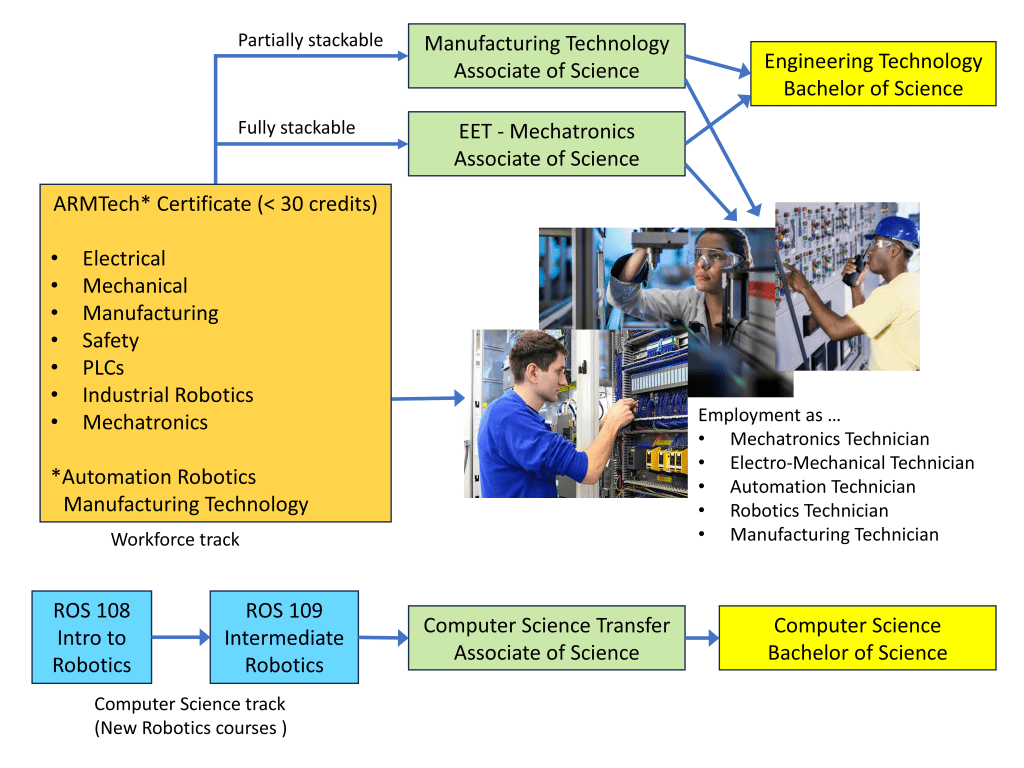
ARMTech received final state approval and launched as a 29-credit certificate program. The curriculum integrates Manufacturing Technology (MNT), Electronics Engineering Technology (ELT), and Electro-Mechanical (ELM) courses aligned to the validated BILT/DACUM competencies (Table 2), and implementation was supported by upgraded lab resources (e.g., Amatrol Mechanical Drives training and FANUC-based robotics platforms). To support both immediate employment and continued education, the project formalized stackable pathways from the certificate into associate- and bachelor-level options (Fig. 1).
Pathway 1: Direct entry into technician employment upon completion of the certificate.
Pathway 2: Stackable progression to an Associate of Science in Electronics Engineering Technology – Mechatronics Option, leading to employment and/or a Bachelor of Science in Engineering Technology.
Pathway 3: Partially stackable progression to an Associate of Science in Manufacturing Technology, leading to employment and/or a Bachelor of Science in Engineering Technology.
Pathway 4: Progression through ROS 108 and ROS 109 into associate and bachelor’s degree pathways in Computer Science or Robotics Engineering, supported by QCC articulation agreements.
Faculty Professional Development Outcomes (Goal 2)
Faculty professional development supported consistent delivery of project-based instruction and safe, effective use of new equipment. Professional learning included external training on project-based learning, conference participation in benchmark ATE practices, vendor and software training for automation platforms, and internal workshops to align course outcomes, lab activities, and assessments with the ARMTech competencies.
Outreach and Recruitment Outcomes (Goal 3)
Outreach outcomes included the Women in Robotics Meet and Greet, which generated strong interest (62 registrants; 14 attendees) and five immediate ARMTech enrollments (Table 3). Recruitment messaging was reinforced with a fact sheet summarizing wage progression and career outcomes, including certificate-to-degree pathways (Table 4).
Early Enrollment Indicators
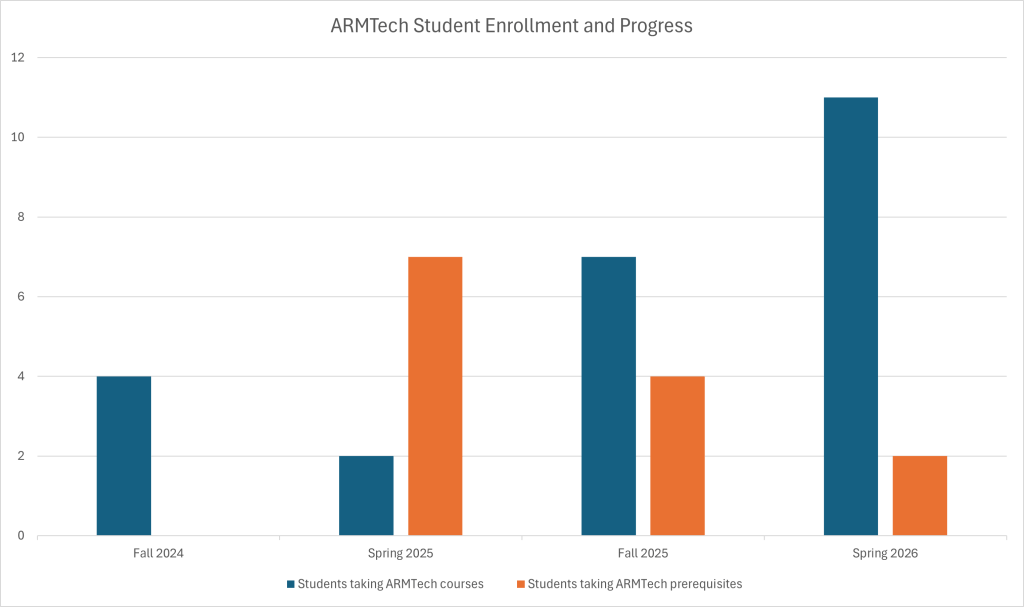
Enrollment was tracked at term snapshots in three categories: (1) Active—students registered in at least one ARMTech course; (2) Prerequisite pipeline—students completing required preparatory coursework (e.g., mathematics) prior to ARMTech courses; and (3) Declared ARMTech—students who indicated ARMTech as their program but had not yet registered for ARMTech or prerequisite courses at the snapshot date (Table 5).
Across the first four semesters, the combined Active + Prerequisite pipeline population increased from 4 to 13 students (Fig. 2), and three students are projected to complete the certificate in May 2026. The Declared ARMTech category provides an early indicator of interest, but it does not represent course participation until students register.
Table 5. Enrollment, progress, and projected certificate completion (Fall 2024–Spring 2026)
| Term (snapshot date) | Active in ARMTech courses | Prerequisite pipeline | Declared ARMTech (no courses yet) | Active+ Prerequisite Pipeline | Notes |
| Fall 2024 (Sept 9, 2024) | 4 | 0 | 5 | 4 | Program launched after state approval (Summer 2024). |
| Spring 2025 (Mar 21, 2025) | 2 | 7 | 14 | 9 | Seven students completing prerequisite mathematics. |
| Fall 2025 (Sept 30, 2025) | 7 | 4 | 18 | 11 | Growth in active enrollment as prerequisite students progressed. |
| Spring 2026 (Feb 2, 2026) | 11 | 2 | 23 | 13 | Three students are projected to complete the certificate in May 2026 (2 female, 1 male). |
Strategic Partnership Outcome
In 2024–2025, the project established a partnership with Amazon Robotics to strengthen employer validation and placement pathways. The partnership began through outreach by QCC’s STEM Program Administrator (Adrienne Linnell) to Amazon Robotics (Bonnie Perkins), followed by reciprocal site visits: a QCC team toured Amazon Robotics in Westborough on November 4, 2024, and Amazon Robotics representatives visited QCC on January 23, 2025, to tour the Manufacturing and Electronics Engineering Technology labs and plan partnership activities. Amazon Robotics expressed interest in the ARMTech certificate as a talent pipeline and indicated that current employees may enroll in ARMTech; the company also offered to host field trips for QCC students, creating additional opportunities for student engagement and industry feedback.
Discussion
Limitations
These findings reflect early implementation and should be interpreted cautiously. Enrollment counts are reported as point-in-time snapshots and include a “Declared ARMTech” category that signals interest but not course participation (Table 5). In addition, many students entered through prerequisite coursework (especially mathematics), so credential completion outcomes are not yet mature. Because the sample remains small, the paper focuses on descriptive indicators rather than causal claims about recruitment effectiveness or student success.
Lessons learned for replication and dissemination
Recruiting and onboarding a new industry/BILT partner: initial contact, a clear value proposition (a vetted 29‑credit certificate aligned to technician roles), and reciprocal site visits helped establish momentum. With Amazon Robotics, early engagement included facility tours, lab tours, and defining concrete next steps (employee enrollment options and student field trips).
Recruitment strategies: women-focused messaging and role-model visibility generated high interest (e.g., strong registration numbers for the Women in Robotics event), but conversion depended on follow-up and clear next steps. Consistent with NSF guidance, targeting women for outreach did not restrict participation; men were welcomed and enrolled.
Retention and progression strategies: advising and communications emphasized math readiness early, and the project tracked a prerequisite pipeline to support scheduling and course sequencing. This approach helped convert declared interest into course participation as students completed prerequisites.
What did not work (or remains incomplete):pandemic-related disruption reduced access to informal robotics pipelines (e.g., VEX activities), and early enrollment was insufficient to run ROS 108/109 and collect planned student feedback surveys. Sustained longitudinal tracking beyond initial implementation remains necessary to document completion, transfer, and employment outcomes.
To support reuse by other colleges, the team will continue sharing curriculum artifacts through ATE community venues (e.g., NSF ATE PI Conference and HI‑TEC participation) and make course outlines, the KSA/DACUM-to-curriculum mapping, and lab implementation notes available upon request. At the time of writing, formal adoption by other institutions has not yet been documented, but the intent is to package the materials for broader dissemination as additional outcome data become available.
The results also underscore the importance of women-focused outreach [3, 4]. Recruitment activities that centered on women role models and women-specific messaging (e.g., the Women in Robotics Meet and Greet and associated materials) align with NSF’s broadening-participation priorities and may strengthen both recruitment and persistence. In parallel, the Amazon Robotics partnership provides a promising mechanism for continued employer feedback and potential placement opportunities, further reinforcing program relevance.
Conclusion
The SPARC project at Quinsigamond Community College established an industry-aligned ARMTech certificate grounded in employer-validated competencies and supported by upgraded labs and faculty professional development. Early enrollment results show a growing pipeline shaped by prerequisite pathways (Table 5). The Amazon Robotics partnership strengthened employer engagement and expanded opportunities for student exposure and feedback. Future work will focus on longitudinal tracking of completion, transfer, and employment outcomes, and on packaging curriculum artifacts and implementation lessons to support replication by other colleges.
Acknowledgements. This work was supported by the National Science Foundation under Award No. 1954577, Student Produced Autonomous Robotic Creations (SPARC). The authors gratefully acknowledge the contributions of Quinsigamond Community College faculty and staff, including Professor Lee Durden and Professor Damian Kieran, for their leadership in curriculum design and industry engagement. Special thanks are extended to Adrienne Linnell, STEM Program Administrator, for her administrative guidance, and to Donna Milgram of the National Institute for Women in Trades, Technology & Science (IWITTS) for her expertise in developing targeted recruitment strategies. We also thank our industry partners, particularly Amazon Robotics, SMC Ltd, and Valmet, for their collaboration and validation of the ARMTech curriculum. Finally, we wish to acknowledge the late Professor Jacob Longacre, the original Principal Investigator, whose vision and dedication laid the foundation for this project.
Disclosures. The authors declare no conflicts of interest.
[1] Massachusetts Department of Higher Education. (2015). Advanced Manufacturing Workforce Plan: A Foundation for Our Future (Spring 2015). https://www.mass.edu/strategic/documents/16a_AttachmentAdvancedManufacturingWorkforcePlan_Spring2015.pdf
[2] National Science Board. (2024). S. STEM workforce: Size, growth, and employment. National Center for Science and Engineering Statistics (NSB-2024-5). https://ncses.nsf.gov/pubs/nsb20245/u-s-stem-workforce-size-growth-and-employment
[3] Advanced Technological Education (ATE) Community. (2025). ATE impacts: Report on community college workforce credentials. ATE Central. https://ate.community/impacts
[4] Abbas, R., & Abbas, S. (2024). Developing PLC and robotic automation technician certificate program and service industries. National Science Foundation. https://par.nsf.gov/biblio/10503614
[5] (2025). 100+ women in STEM statistics — U.S., 2025. AIPRM Research. https://www.aiprm.com/women-in-stem-statistics/
[6] Society of Women Engineers. (2025). Global STEM workplace: SWE research brief. SWE Research. https://swe.org/research/2025/global-stem-workplace/
[7] Norton, R. E. (1997). DACUM handbook. Center on Education and Training for Employment, College of Education, The Ohio State University.
[8] Fine, S. A., & Cronshaw, S. F. (1999). Functional job analysis: A foundation for human resources management. Lawrence Erlbaum Associates.