This PDF can be viewed here or downloaded and contact info is at end of the file. The QR code is also scannable and will open a browser and take you to the main page if you point your smartphone camera at it.
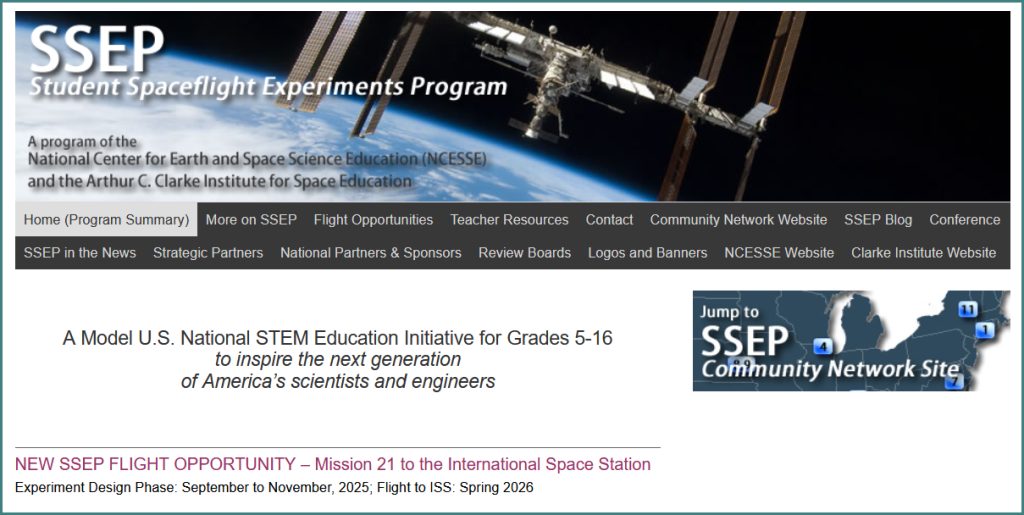
The Student Spaceflight Experiments Program (SSEP) Mission 21 selections are now official, with multiple student research teams chosen for flight experiments aboard the International Space Station (ISS). (Links at end of this section to SSEP, which is a program of the National Center for Earth and Space Science Education (NCESSE), and its sponsor: Rhodium Scientific.)
Pasadena City College (PCC Pasadena) was selected for a project examining the effect of microgravity on the crystallogenesis of Hen Egg White Lysozyme—a project supported through our efforts.
- Community colleges are strongly represented across the Student Spaceflight Experiments Program (SSEP) Mission 21 to ISS, highlighting national impact beyond four-year institutions.
Selected Teams – SSEP Mission 21
- Edmonton, AB (Canada) – Edmonton Public Schools
- Mississippi Mills, ON (Canada) – Mississippi Mills Area Schools
- Mesa, AZ – Mesa Public Schools
- Phoenix, AZ – Paradise Valley Unified School District
- Glendora, CA – Glendora Unified School District
- Pasadena, CA – Pasadena City College
- Colorado Springs, CO – University of Colorado
- Melbourne, FL – Florida Institute of Technology
- Orlando, FL – University of Central Florida
- St. Petersburg, FL – St. Petersburg College
- Tampa, FL – University of South Florida
- New Orleans, LA – Tulane University
- Lowell, MA – University of Massachusetts
- Omaha, NE – Metropolitan Community College
- Albany, NY – City School District of Albany
- Asheville, NC – Asheville-Buncombe Technical College
- Athens, OH – Ohio University
- Pittsburgh, PA – Community College of Allegheny County
- San Antonio, TX – North East Independent School District
- iForward – Grantsburg, WI – Grantsburg School District
SSEP is a program of the National Center for Earth and Space Science Education (NCESSE) in the U.S. and the Arthur C. Clarke Institute for Space Education internationally. It is enabled through a strategic collaboration with Rhodium Scientific, America’s first commercial space biotech. Research reported herein was supported by the Center for the Advancement of Science in Space, Inc. and NASA under agreement number 80JSC018M0005 and with Rhodium Scientific under agreement number UA-2021-8282.