Shoutout to our Co-PI, Dr. Peter Kazarinoff for his dedication and efforts to supporting all technician training.
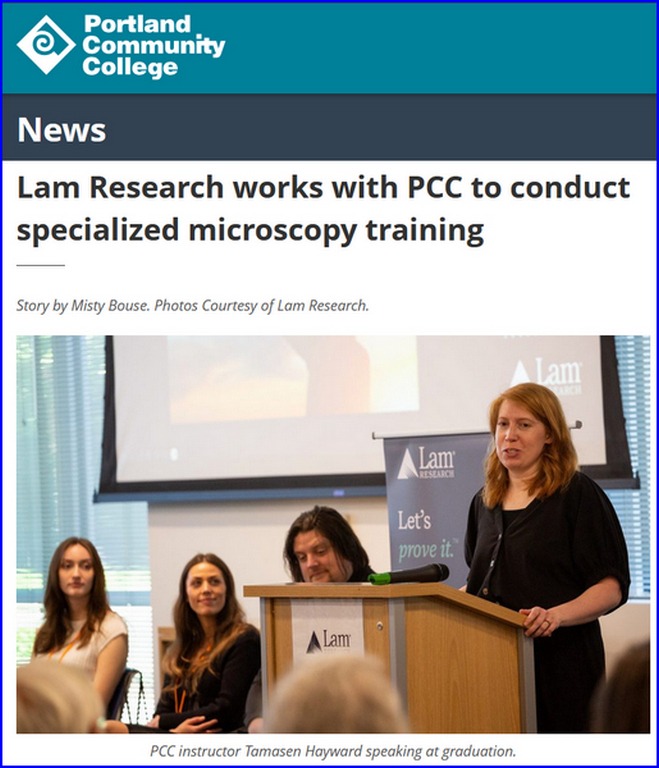
Portland Community College (PCC) and Lam Research have completed an important milestone in Oregon’s growing semiconductor workforce pipeline: the graduation of the first cohort of students from the new Microscopy Technician Training Program.
The eight-week program provided 40 hours of hands-on experience with advanced microscopy and inspection technologies used throughout semiconductor manufacturing (held at Lam’s Tualatin campus). Participants trained directly on scanning electron microscopes (SEMs) and other industry-relevant tools, gaining exposure to real-world workflows inside a semiconductor equipment company.
According to the PCC news article, the program began when Lam approached the college’s Microelectronics Technology Program to explore short-term training aligned with urgent technician needs. PCC’s Professional Development & Training (PDT) team then led development and implementation of the program in close collaboration with Lam experts.
Brian Clay, Global Operations Program Manager at Lam Research, emphasized that microscopy requires a “unique blend of specialized, highly technical skills, attention to detail, and creative problem-solving,” and noted this program “brought all those and more.”
Lam Research Foundation funding helps PCC broaden its STEAM Center programs, reaching students across the district with hands-on workshops in 3D printing, design, and rapid prototyping. Over 2,000 students have already benefited from these makerspace experiences.
Tualatin Mayor Frank Bubenik highlighted the program’s economic importance, noting that the computers and electronics sector is “more important to the Oregon economy than in any other state.”
With plans already underway for a second cohort in 2026, PCC reports that the PDT team will continue adapting workforce-aligned training as Oregon ramps up semiconductor education and technician development.
The Micro Nano Technology Education Center (MNT-EC) is pleased to announce that Billie Copley has been promoted to Center Director. Billie has served as Center Manager since the Center’s founding, working closely with Dr. Jared Ashcroft, Principal Investigator (PI) and overall leader of MNT-EC.
This promotion reflects Billie’s leadership, dedication, and growing role in guiding Center activities. Dr. Ashcroft will continue to provide strategic vision, build national partnerships, and shape the Center’s long-term direction as PI, while Billie expands her responsibilities as Center Director, ensuring strong coordination across projects, partners, and outreach efforts. Together, they will continue advancing the Center’s mission of supporting educators, students, and industry in micro and nanotechnology education.
“Working alongside Billie over the past several years has shown me just how committed she is to our mission. She has an incredible ability to connect with people, keep our projects moving forward, and ensure that everyone feels supported. Promoting her to Center Director is a natural next step, and I’m grateful we get to continue building MNT-EC together.” – Dr. Jared Ashcroft, Principal Investigator, MNT-EC
“Being part of MNT-EC since the beginning has been such a meaningful experience for me. I’m grateful for the trust and support of Jared, our team, and our partners, and I’m excited to keep building this work together. Stepping into the role of Center Director is both energizing and humbling, and I can’t wait to see what we accomplish next.” – Billie Copley, Center Director, MNT-EC
Two students from Pasadena City College (PCC) were among the select few undergraduate researchers presenting at the prestigious CAMPS 2025 Conference, hosted May 23–24 at Texas State University in San Marcos, Texas.
Supported by the NSF’s PREM (Partnerships for Research and Education in Materials) and MRSEC (Materials Research Science and Engineering Centers) programs, CAMPS brings together student researchers from across the country to present innovative work in materials science, biology, chemistry, and related fields.
While most attendees hailed from four-year institutions—a reflection of where PREM and MRSEC funding is typically centered—these two students from PCC stood out for their research contributions, poise, and academic rigor.
The participation of two-year students at CAMPS 2025 this year signals a noteworthy shift—one that points to the importance of fostering inclusive research pathways at all academic levels.
Poster Presentation: Safety of Brain Implants in Living Organisms
Carlton Mantovani: Pasadena City College | AT3 Internship Program | NSF PREM #2425226
Carlton’s research poster explored the neurological effects of brain microchip implants in animal models, particularly in rhesus macaques and sheep. His work focused on measuring whether such implants—used to study or even treat neurological diseases—cause long-term harm to cognitive function or brain tissue.
Using MRI imaging, behavioral Delayed Non-Matching-to-Sample (DNMS) tests, and biomarker analysis (GFAP and IBA-1 expressions), Carlton found no significant memory impairment or tissue damage. His findings suggest that brain implants could play a safe and influential role in neuroscience in the future.
“This type of advanced, interdisciplinary work is exactly the kind of research we want to see coming out of programs like AT3 and PREM,” PCC professor and student mentor, Dr. Jared Ashcroft, said. “Carlton’s results were well-documented and thoughtfully presented—it was a proud moment for our team.”
Poster Presentation: Pollution and Biodiversity at the Audubon Center
Phone (Morest) Myint Mo: Pasadena City College | Department of Natural Sciences
Morest’s research examined biodiversity loss due to urban air and noise pollution in two plots at the Audubon Center in California—Monarch Alley and Hummingbird C. By collecting data on air quality (PM2.5, PM10, VOCs), noise levels, and plant species counts (using iNaturalist and Shannon diversity index), the team discovered a clear correlation: the less polluted site had higher biodiversity and healthier vegetation.
His group used leaf area measurements of native oak species as indicators of physiological stress and found that air and noise pollution had a measurable adverse effect on these species.
Morest, a STEM tutor and Vice President of the Resilience Club at PCC, plans to transfer to UC Berkeley in Fall 2025 to pursue Molecular and Cellular Biology. He brings a deeply interdisciplinary perspective to science, linking biology, chemistry, and physics with real-world sustainability and public health issues.
A Sign of Progress
“To our knowledge, they were the only community college students presenting at the conference this year,” Dr. Jared Ashcroft said. “Their work was just as advanced and compelling as that of students from major research universities.”
As CAMPS continues to grow (this year marked only its third occurrence), participation from two-year institutions remains less common—but meaningful. The presence of these students at such a high-level national research forum reflects the increasing role community colleges are playing in shaping the future of science and innovation.
“We hope their stories inspire other students and institutions to aim high and pursue research opportunities that might once have seemed out of reach,” said Dr. Ashcroft.
Hosted by The Texas State University PREM Center for Intelligent Materials Assembly (CIMA) with 94 students from over 30 PREM and MRSEC institutions nationwide.
Included in the program:
Invited speaker series featuring four faculty and three industry presenters
Two rapid-fire oral presentation sessions (38 student presenters)
Two poster sessions (87 posters presented)
A career panel and industry networking lunch
A lab tour of Texas State’s Shared Research Operations, featuring demonstrations of SEM, TEM, EDS, and a nanofabrication clean room
CAMPS at a Glance content provided by Dr. Tania Betancourt, Professor of Chemistry and Biochemistry at Texas State and Director of the PREM Center for Intelligent Materials Assembly.
Ashley is an RDA process technician at Micron in Manassas, Virginia. Ashley describes her role in inspecting wafers for imperfections and ensuring high-quality chips. She works shifts from Wednesday to Saturday, earning a starting wage of $20-$25 per hour, with potential differentials for night shifts. Benefits include excellent healthcare and retirement plans. Ashley emphasizes the importance of communication and adaptability, crediting her community college education and internship at Micron for her success.
Show Notes
Ashley is an RDA process technician at Micron in Manassas, Virginia. Ashley describes her role in inspecting wafers for imperfections and ensuring high-quality chips. She works shifts from Wednesday to Saturday, earning a starting wage of $20-$25 per hour, with potential differentials for night shifts. Benefits include excellent healthcare and retirement plans. Ashley emphasizes the importance of communication and adaptability, crediting her community college education and internship at Micron for her success. She advises students to try new experiences and not be afraid to explore different career paths.
The Talking Technicians podcast is produced by MNT-EC, the Micro Nano Technology Education Center, through financial support from the National Science Foundation’s Advanced Technological Education grant program.
Opinions expressed on this podcast do not necessarily represent those of the National Science Foundation.
Join the conversation. If you are a working technician or know someone who is, reach out to us at info@talkingtechnicians.org.
Five years ago, we set out to build something bold: a national center that could connect students, educators, industry, and community colleges nationwide in the name of micro- and nanotechnology workforce development.
We didn’t know exactly where it would take us—but we knew it had to begin with students, with skilled faculty, and with a belief that community colleges could lead the way. That belief wasn’t just a hypothesis. It’s a reality we have helped shape—and one we plan to build on over the next five years.
Photo Caption: This photo is from the J ATE annual meeting, but it has so many of our team and partners that we decided to use it for today’s final (for this cycle) Director’s Message.
Lifting Others Up
From our earliest days, MNT-EC has been about elevating others. We’ve helped students access internships, apprenticeships, research opportunities, and real-world experiences that open doors and build confidence. Programs like AT3, MNT-CURN, and the Talking Technicians podcast have given students a platform and a pathway. We’ve also worked with educators—through mentor programs, curriculum development, and community building—to create a national ecosystem of teaching and training that supports technician education at its highest level.
Our Student Success series, launched in recent years, highlighted what we’ve always known: When you listen to students and share their voices, you validate their efforts and inspire all of us.
Let’s say that one more time for the folks in the back…
When you listen to students and share their voices, you validate their efforts and inspire all of us.
-MNT Leadership Team
A Partnership from the Start
As Billie writes:
“I received several calls back in 2019—Jared had reached out about building this center, and before I knew it, six years later, we were running it side by side.”
That first call turned into a full partnership. And what grounded us was a shared philosophy: do the real work, keep it student-centered, and make sure what we build can last. We’ve had little patience for anything less than genuine effort. When something didn’t work, we pivoted—with transparency, urgency, and a focus on what would serve our mission.
And we showed up. Whether it was lab workshops, grant deadlines, student video editing sessions, or early morning check-ins, we were committed because we believed in what we were building.
Acknowledging the Work—and the People Behind It
This progress hasn’t happened in isolation. It’s happened because of people. We want to thank the Co-Principal Investigators who helped shape this vision from day one: Mel Cossette, Peter Kazarinoff, Neda Habibi, and Greg Kepner. You can read their short bios linked just below.
To our external evaluation teams—The Allison Group and MUME Collective—thank you for helping us reflect, adapt, and grow stronger. They won an award for their amazing evaluation work: MNT-EC Evaluators Recognized Nationally.
To our partners across education and industry—your belief in technician education and your willingness to invest time, insight, and energy have made the difference. You deserve and have our deepest gratitude and appreciation.
Thank you, SEMI Foundation, Natcast, and NIICA, for your collaboration and commitment to building training pipelines that serve real workforce needs.
We’re also in awe and so completely grateful to the hundreds of community college faculty, students, and industry leaders who helped shape this center.
Our mission remains clear as we enter the next five-year chapter: strengthen technician education, create equitable access to opportunity, and ensure community colleges are front and center in the nation’s workforce development conversation.
To the students: Keep applying. Keep asking questions. Keep showing up.
To the educators: Your mentorship echoes far beyond your classroom.
To our partners: Let’s keep building—boldly, together.
UPDATE: If you did not receive our latest MailChimp email update, you can read the deets on LinkedIn for Dr. Ashcroft’s newest exploit with the “alligator.” (And join our growing LinkedIn page/community for the nano stuff you just don’t want to miss. 😉
I met Jared in 2012 when he was part of Nano-Link’s Nano-Infusion Project. We exchanged a few emails but didn’t know each other except by name. In early 2019, I received frantic phone calls from a couple of members of the MNT community telling me that Dr. Ashcroft was trying to reach me. I had no idea who Dr. Ashcroft was because the only Ashcroft I knew was Jared. I did not think he was a “Dr.” I called him, and he asked me if I would be interested in being the center manager for a grant they were writing for a national center. And now, here we are, six years later, loving our jobs and what we do in the MNT community.
Jared is passionate about his family, students, and those working with him. You will hear him joke a lot about everything, but he is dedicated to this community, especially to community colleges and their faculty and students. His passion project is AT3, but he also helps students on a MATEROV team that Pasadena City College has; he opens his lab every Saturday for students to come in and learn, and he is constantly pushing his students to apply for grants, scholarships, awards, and competitions. He enjoys bringing students to conferences to present posters, be on student panels, and meet industry professionals.
It has been absolutely amazing to work alongside Jared for the past six years. We have learned from each other, leaned on each other, and successfully run the Micro Nano Technology Education Center together. We have a strong and dedicated team that lifts the two of us, guides us, and makes sure we don’t screw up. Jared has been an amazing PI and a good friend.
I look forward to working alongside Jared for another five years or more.
***
What would you like people to know about you?
Well, first and foremost, I am the reigning MNT-EC Axe Throwing Champion and proud winner of the most recent MNT-EC Golf Championship, generously “sponsored” by the Dove Corporation of Argentina (a reference only Bob Ehrmann will truly appreciate). I like to bring a sense of fun and lightheartedness to the work we do—because enjoying what we do matters.
That said, I also take this work very seriously. I’m deeply committed to the goals we set and the promises we make to one another, especially when it comes to supporting students and building meaningful programs. I have very little patience for individuals or organizations that don’t follow through. At the very least, we owe it to ourselves—and each other—to make a genuine effort to collaborate, communicate, and follow through on our commitments.
And if something isn’t working? Let’s be honest about it. After giving it a real shot, it’s okay to pivot to a new strategy—as long as we’re doing it with intention, transparency, and in service of the mission. That’s how we grow. That’s how we get better. And, ideally, that’s how we keep having a little fun along the way.
What advice would you give to young people going to college who are interested in the field of manufacturing and nanotechnology?
First, you don’t need to have it all figured out on day one. Manufacturing and nanotechnology are huge, exciting fields with so many pathways—from cleanroom fabrication to process engineering to quality control and beyond. Start with curiosity. Take introductory courses, get your hands on equipment when you can, ask questions, and don’t be afraid to try things that feel unfamiliar or even a little intimidating.
One of the most important things you can do early on is build a strong foundation of practical skills. Learn how to use basic lab tools, read schematics, follow safety protocols, and understand how systems work at a fundamental level. These skills are transferable across industries and will set you apart when opportunities come your way.
Also, get involved as early as possible—whether that’s through internships, research programs, student clubs, or campus makerspaces. Hands-on experience is everything in this field. Not only will it help you apply what you’re learning in class, but it will also build your confidence and help you start building a professional network. And yes, start checking your email regularly—you’d be surprised how many students miss opportunities just because they didn’t read a message in time!
Equally important: don’t underestimate the value of soft skills. The best engineers and technicians are also great communicators, collaborators, and problem-solvers. Work on time management, learn how to work effectively in a team, and develop the ability to think critically and adapt when things don’t go as planned (which they often won’t).
And finally, say yes to opportunities—even if you don’t feel fully ready. Apply for internships, research positions, and summer programs. You don’t have to be perfect; you just have to be open and willing to learn. Programs like those supported by MNT-EC and initiatives like CASCADE and the Advanced Technology Technician Training program exist to help students like you explore, grow, and succeed.
Manufacturing and nanotechnology are shaping the future—and there’s a place for you in it. So stay curious, stay humble, and most of all, stay engaged. You never know where that first step might take you.
What advice would you give to students and/or fellow educators in the field of micro and nanotechnology?
To students entering the field of micro and nanotechnology—or really any technical field—my first piece of advice is simple but important: check and respond to your emails. I know it sounds basic, but I can’t tell you how many students miss out on scholarships, internships, events, or research opportunities simply because they’re relying on communication platforms like Discord or group chats, while faculty and professional networks still primarily use email. Staying engaged and responsive is a key part of being taken seriously and showing you’re ready to take on professional opportunities.
Beyond that, I encourage students to focus on developing strong soft skills—things like time management, critical thinking, persistence, and the ability to communicate effectively. These aren’t just “nice to have” traits; they’re essential to thriving in any academic or career setting. Technical knowledge alone isn’t enough—how you work, how you think, and how you interact with others will determine your long-term success.
Another important mindset shift I try to emphasize is this: stop trying to master the most complex concepts right away. Too many students get discouraged when they don’t understand the hardest material right off the bat. But the truth is, even in advanced fields like micro and nanotechnology, the most valuable skillset is a solid foundation in the fundamentals. Learn how to use a multimeter. Get comfortable with cleanroom protocol. Understand the basics of fabrication processes, measurements, and safety. These are the skills that make you valuable across many disciplines and roles. Industry will teach you the specifics of their systems—they expect to train you. What they’re really looking for is someone with curiosity, initiative, and a strong technical core.
And here’s something I can’t emphasize enough: apply for as many internships as possible. And when you get one—be exceptional. Show up early. Ask questions. Take notes. Offer to help. These are the things that build your reputation and, more importantly, your professional network. In this field (and many others), opportunities often come not just from what you know, but who you know. The mentors, supervisors, and colleagues you meet early on can open doors you didn’t even know existed.
To my fellow educators: we need to help students see the big picture. Let’s keep pushing for curriculum that balances technical training with soft skill development, and let’s model professional communication and behavior in our own interactions. Programs like those supported by MNT-EC, CASCADE, START, and our Advanced Technology Technician Training (AT3) initiative are powerful because they blend technical rigor with real-world application—and that’s exactly what our students need.
At the end of the day, this field is about growth—personal, professional, and technological. Stay open, stay curious, and say yes to opportunities, even when they push you out of your comfort zone. That’s where the real learning happens.
What do you love best about your work?
Alright, I’ll let you in on a little secret—I’m not a great research scientist. I didn’t pursue a Ph.D. because I had a burning desire to lead groundbreaking experiments or publish in prestigious journals. I did it because, at the time, it was the only clear path to do what I actually love: teach. Specifically, to teach at the college level and create environments where students could explore, discover, and grow.
What I truly love about my work is being in the background, creating the conditions for others to thrive. I’m not someone who wants to be in charge of everything or in the spotlight. My passion lies in quietly building opportunities that help students succeed—whether that’s facilitating research experiences, organizing internships, or setting up lab environments where they can experiment, get curious, and maybe even mess up a little in the process. That’s where the learning happens.
One of my favorite parts of the job is seeing students present their work—whether at conferences, in classrooms, or during lab tours. Watching them take ownership of their ideas, speak with confidence, and realize they belong in STEM spaces is incredibly rewarding. When a student gets published, lands an internship, or just tells me they finally understand something that used to feel impossible—that’s the moment that makes everything worth it.
I’ve come to realize that my role isn’t about being the smartest person in the room—it’s about being the person who helps make things possible. Whether through programs like CASCADE, AT3, or our work with MNT-EC, I get to help create bridges between students and opportunity. And that’s something I’ll never take for granted.
What I love best about my work is that it’s not really about me—it’s about them. Their growth, their confidence, their next steps. And if I can play even a small part in that journey, I’m exactly where I’m supposed to be.
That said, I have to give credit to MNT-EC for pushing me out of my comfort zone in the best way possible. For someone who never really wanted to be “in charge,” being part of this national effort has opened up a whole new chapter for me. MNT-EC has given me the space—and the responsibility—to lead in ways I never expected. It’s been both challenging and incredibly rewarding. It’s helped me grow professionally and personally, and reminded me that leadership doesn’t always look like taking center stage. Sometimes it means shaping systems behind the scenes, supporting others as they rise, and realizing that you’re capable of more than you thought.
What impact do you hope MNT-EC will have on instructors and students and the world of education in general?
As an educator and someone deeply involved in the education and workforce development space, I believe one of the most important things we can do is provide students and faculty with meaningful opportunities—and continually encourage them to take full advantage of those opportunities. Access, support, and encouragement are key to helping individuals reach their potential, especially in specialized, high-tech fields like micro and nanotechnology.
The Micro Nano Technology Education Center (MNT-EC) is a vital partner in this effort. Its mission to expand the number of community college programs and educators delivering outcomes that lead to technician jobs in micro and nanotechnology industries is directly aligned with the needs of the 21st-century workforce. Through MNT-EC’s support, institutions are able to develop cutting-edge curriculum, offer hands-on training experiences, and connect with a national network of peers and industry partners.
Programs like CASCADE—which stands for California Alliance for Semiconductor Career and Development Expansion—are a direct example of how MNT-EC’s mission comes to life. CASCADE is focused on building a strong, inclusive pipeline for technician roles within the semiconductor industry, particularly in Chip Design. With a focus on outreach, training, and career alignment, CASCADE creates real opportunities for students from diverse backgrounds to enter and thrive in high-demand technical careers. MNT-EC’s partnership in initiatives like CASCADE ensures that faculty are equipped with the tools, training, and support they need to deliver relevant and transformative education.
We also see this impact in our Advanced Technology Technician Training (AT3) program. This program is designed to provide community college students and instructors with immersive, hands-on experiences in micro and nano, and emerging technologies. Through structured training modules, access to cutting-edge equipment, and direct engagement with industry professionals, AT3 strengthens the technical foundation of students while helping faculty stay current with industry practices. The program is not only a pathway to employment, but also a catalyst for increasing student confidence and awareness of careers in fields they may not have previously considered.
On a larger scale, MNT-EC is helping to redefine education by promoting industry-responsive, workforce-aligned models that prioritize skills development, hands-on experience, and real-world application. This shift not only benefits students and educators, but also addresses critical talent gaps in emerging sectors, ensuring that our education system remains relevant and resilient in the face of technological change.
Ultimately, I hope that MNT-EC continues to serve as a national leader in empowering instructors and students, and in shaping a more inclusive, agile, and impactful educational ecosystem—one that opens doors to careers that truly transform lives and communities.
I’m thrilled to introduce Dr. Neda Habibi in this month’s Partner Spotlight. I met Neda in 2019 when we first started writing the MNT-EC grant. She was quiet and full of passion. I have come to love the conversations that she and I have had over the years. Neda is one of the smartest women I have ever met, and I am better for having known her over the past five years. She is an inspiring educator and researcher at the University of North Texas whose passion for mentoring and hands-on learning is helping shape the future of the biomedical workforce.
Through her work with MNT-EC, she’s bringing students into the world of nanobiotechnology in powerful and practical ways—empowering them to see themselves as future scientists, innovators, and leaders. I’m so grateful to have her in our community.
***
Can you share your background and the pioneering work you’ve done in your field?
I am a faculty member in the Department of Biomedical Engineering at the University of North Texas, where my research focuses on nanomedicine, drug delivery, and tissue engineering. As part of the Micro Nano Technology Education Center (MNT-EC), I have been actively involved in outreach and workforce development by organizing and leading nanobiotechnology summer camps. These programs provide high school and college students with hands-on experiences in areas such as 3D bioprinting, cell culturing, and advanced bioinstrumentation.
Through these efforts, I aim to inspire students to pursue STEM careers and equip them with the technical skills and confidence needed for the future biomedical workforce.
What impact do you hope MNT-EC will have?
I hope MNT-EC continues to be a driving force in making micro and nanotechnology accessible and engaging for students and educators across the country. Through hands-on experiences and mentorship, like those we offer in our nanobiotechnology summer camps at University of North Texas, MNT-EC has the potential to inspire the next generation of scientists, engineers, and innovators, while equipping educators with cutting-edge resources to enhance STEM education. I believe this initiative not only improves workforce readiness but also fosters curiosity and participation for all who want to be involved in advanced science fields.
What advice do you have for students and educators in this field?
Stay curious and embrace hands-on learning. Micro and nanotechnology are inherently interdisciplinary, so don’t hesitate to explore how these fields intersect with biology, chemistry, medicine, and engineering.
For educators, I’d say prioritize experiential learning and mentorship, students thrive when they can apply theory to practice and see the real-world impact of their work.
What do you love best about your work?
What I love most is mentoring students and seeing their excitement when they engage in real-world applications of science, whether it’s culturing cells, 3D printing tissues, or exploring cutting-edge drug delivery systems. Watching students gain confidence, develop skills, and discover new career pathways is incredibly rewarding. It’s even more meaningful when you know these experiences could shape their futures.
Advice for young people considering this field?
Take advantage of every opportunity to get hands-on experience—internships, workshops, research projects. These experiences will help you build technical skills and discover what areas truly excite you. Also, don’t be afraid to ask questions or seek mentors; the field is full of passionate people who are eager to support young talent. And remember, the most innovative solutions often come from interdisciplinary thinking.
What else should we know?
I’m passionate about building open pathways for students into STEM fields, especially through mentorship and hands-on learning. I believe that giving students early exposure to advanced tools and techniques empowers them to envision themselves as future scientists and engineers. Through my work, I aim to bridge the gap between academic training and real-world applications, preparing students not just for careers, but for leadership in science and technology.
Dr. Neda Habibi, in collaboration with Northwest Vista College and the University of Texas at San Antonio (UTSA), led a National Science Foundation (NSF)-funded initiative to provide undergraduate students with hands-on experience in biomedical engineering research. This program offered students the opportunity to work with advanced electron microscopy techniques, including Field Emission Scanning Electron Microscopy (FESEM) and Transmission Electron Microscopy (TEM), to develop anti-cancer drugs and tissue scaffolds aimed at improving cancer treatment and tissue regeneration.
Science often begins with a question, a wild idea, or what if? Some of the most significant discoveries started as something that sounded impossible—until someone dared to prove it wasn’t.
Everything we have learned in science has come from a belief that something we did not know, a concept we cannot necessarily see or understand, is possible:
Gravity
Speed of light and sound
Static force
Atoms and molecules
These are all things that we cannot see with our eyes but feel the effects of every day. The process of discovering them came from questioning what we could see around us every day and asking: How is that possible?
Dr. Seuss filled his books with wild inventions, imaginary creatures, and bizarre landscapes. But if you look closer, many of his wacky ideas aren’t just nonsense—they reflect real scientific principles.
Consider these lines from Oh, the Thinks You Can Think!:
“Think left and think right and think low and think high. Oh, the thinks you can think up if only you try!” –Dr. Seuss
That’s what science is all about—thinking up possibilities and then figuring out how to make them real.
When Fiction Becomes Fact
History is full of Seussian-sounding ideas that turned out to be accurate:
The Invisible Becomes Visible: Scientists once thought germs were make-believe. Now, we know they shape our health and lives.
Talking Over Distances: Imagine telling someone in 1850 that we’d one day have pocket-sized devices that let us talk to anyone, anywhere, anytime. That’s science catching up with imagination!
Walking on the Moon: “The moon is out of reach,” they said—until it wasn’t. Neil Armstrong took that small step just 11 years after Dr. Seuss wrote Green Eggs and Ham.
The Science of “What If?”
The STEM fields encourage the same curiosity that Dr. Seuss inspired in his books. It’s about asking questions that seem absurd and then finding ways to test them.
Nanotechnology, for example, was once the stuff of science fiction. The idea that we could manipulate matter at the atomic level—constructing materials one molecule at a time—seemed like fantasy. Now, it is a booming field, revolutionizing medicine, electronics, and energy storage.
But before these discoveries could happen, someone had to imagine them first.
Bringing the Impossible to the Classroom
Teachers and educators have a unique opportunity to spark this thinking in students. One way is by blending storytelling with hands-on science. The NISE Network provides excellent interactive activities that do just that (shoutout to Catherine McCarthy at NISE for these resources):
1. Oobleck: A Real Dr. Seuss Science Experiment – Inspired by Bartholomew and the Oobleck, this experiment lets students explore non-Newtonian fluids, which behave like both liquids and solids. Read here: Exploring Materials – Oobleck | NISE Network.
2. Horton’s Big Idea: Sensing the Invisible – Just like Horton hears the Whos, kids discover that small things exist even if we can’t see them. Click here: Horton Senses Something Small | NISE Network.
3. In this story time program, visitors actively listen to “Horton Hears a Who!” by Dr. Seuss. Before the story is read, children make paper “elephant ears” to wear. After the story, they use their sense of smell to explore scent molecules that are too small to see. Read here: Horton Hears a Who! Storytime | NISE Network.
Encouraging the Next Generation of Innovators
Dr. Seuss wasn’t a scientist, but he taught us the mindset of one:
Stay curious.
Challenge what you think is impossible.
Embrace the power of “What if?”
Every major scientific breakthrough started as just a thought—a think someone dared to think. If we can encourage students to dream big and explore boldly, who knows what mind-blowing discoveries they’ll make next?
Because, after all…
“You have brains in your head. You have feet in your shoes. You can steer yourself any direction you choose.”
Gracious Mhlanga: Pursuing a Future in Cellular Biology and Cancer Research
For Gracious Mhlanga, science isn’t just about understanding the world—it’s about changing it. A Zimbabwean-American and sophomore at Pasadena City College (PCC), Gracious is passionate about how biology can contribute to advancements in medicine. With a strong interest in cancer treatment research, she is making the most of her time at PCC, taking advantage of opportunities to learn, connect, and grow.
“I’ve always been fascinated by how people use science to make positive changes in the world.”
Please tell us a little about yourself and your background.
I graduated from Rosemead High School in 2023 and am currently a sophomore at Pasadena City College. I’m also Zimbabwean-American, and I’ve always been fascinated by how people use science to make positive changes in the world.
What brought you to Pasadena City College, and what are you studying?
I chose to attend Pasadena City College because it was the best financial choice at the time, and PCC had a lot of connections with my high school. I’m majoring in biology.
Academic and Career Goals
What are your academic and career goals?
My academic goal is to transfer to a 4-year university and earn a Bachelor’s in Cellular Biology. As for my career goal, I hope to have a job involving cancer treatment research.
How has your experience at this community college influenced or shaped your goals?
My experience at PCC has helped shape my goals by providing me with opportunities to learn more about what there is to offer in the field of science.
Experience at the Community College
What has been the most rewarding aspect of your time here so far?
The most rewarding aspect of my time at PCC so far has been the people I’ve met and had conversations with. I’ve had the chance to meet people from different backgrounds and passions.
Can you share a memorable experience or highlight from your time at PCC?
A highlight from my time so far at PCC has been some of the labs I’ve gotten to do in my science courses—they are usually my favorite part of the class.
How have the faculty and staff supported your educational journey?
The faculty and staff at PCC, especially Dr. Ashcroft and Dr. Blatti, have helped support me a lot with my academic journey by offering guidance and advice but also informing me of various research opportunities that offer me the chance to gain experience in the things that I’m interested in, such as science.
Challenges and Overcoming Them
What challenges have you faced during your time at PCC, and how have you overcome them?
I faced challenges balancing many classes, especially during my first year at PCC. But I overcame that by utilizing my resources and trying to be on top of everything.
How has the community college environment helped you address these challenges?
The environment at PCC helped me address this challenge by offering us many resources and hearing other students talk about similar challenges.
Involvement and Activities
Are you involved in any clubs, organizations, or extracurricular activities?
I’m a part of the PCC Transfer Bound program, the PCC Biology Club, which I’m the secretary of, and Caltech Connections and the CUR STR program. All of these activities have been positive experiences.
How have these activities contributed to your personal and professional growth?
These activities have helped me grow by allowing me to work on different aspects of my academic journey. For instance, with the transfer process and scientific research.
Connection to the Community
How do you feel your time at PCC has connected you to the broader community?
PCC has provided me with many opportunities to talk with different community members, especially in my classes.
Have you participated in any community service or outreach programs through the college?
Not that long ago, I participated in PCC’s STEM Saturday. It’s where high schoolers come to PCC and learn more about biology. I helped by participating in the Biology Panel, where I talked to the high schoolers about being a biology major.
Advice for Other Students
What advice would you give to new or prospective students considering PCC?
I would say to make sure you are aware of all the resources available to the students at PCC because you never know if one of them could be useful to you. Also, I would say to try not to overwhelm yourself, especially with your course load. Dropping a class is always an option, but after you’ve thought it through.
What resources or support systems have you found most helpful, and would you recommend them to others?
I’ve found that the STEM Center, the PCC counselors, and the professor’s office hours are the most helpful. I would recommend all of those.
Reflection and Future Plans
Looking back, how do you feel your experiences at PCC have prepared you for the future?
My experiences at PCC so far have prepared me for the future by letting me learn how to balance many classes, know when it’s best to drop a class, work with different people in different environments, and gain lab/research skills.
What are your plans after graduation, and how has PCC prepared you for these next steps?
My plans after graduation are to transfer straight to a 4-year college and work towards earning my Bachelor’s degree. My time at PCC has prepared me for these next steps by allowing me to gain many skills from my classes and research experiences.
Gracious Mhlanga’s journey at PCC is a testament to the power of community college education in shaping future scientists and researchers. Her dedication to learning, research, and mentorship exemplifies the opportunities available at PCC.
If you’re interested in learning more about MNT-EC, nanotechnology, or how community colleges are creating pathways in STEM fields, please feel free to reach out.
Arman is a fabrication technician at Excelitas in Boulder, Colorado. Arman moved from Santa Clarita, California, and now earns around $50,000 annually. He grinds and polishes lenses for various applications, including commercial and military uses. Arman emphasizes the importance of detail, communication, and teamwork in his role. He transitioned from a warehouse job to a two-year laser optics program at Pasadena City College. Arman advises aspiring technicians to pursue their passions and seize opportunities.
Show Notes
Arman is a fabrication technician at Excelitas in Boulder, Colorado. Arman moved from Santa Clarita, California, and now earns around $50,000 annually. He grinds and polishes lenses for various applications, including commercial and military uses. Arman emphasizes the importance of detail, communication, and teamwork in his role. He transitioned from a warehouse job to a two-year laser optics program at Pasadena City College. Arman advises aspiring technicians to pursue their passions and seize opportunities.
The Talking Technicians podcast is produced by MNT-EC, the Micro Nano Technology Education Center, through financial support from the National Science Foundation’s Advanced Technological Education grant program.
Opinions expressed on this podcast do not necessarily represent those of the National Science Foundation.
Join the conversation. If you are a working technician or know someone who is, reach out to us at info@talkingtechnicians.org.